 info@nbcoir.com
 +94
Coco Peat vs Coco Chips vs Coco Fiber – Which One Should You Choose?
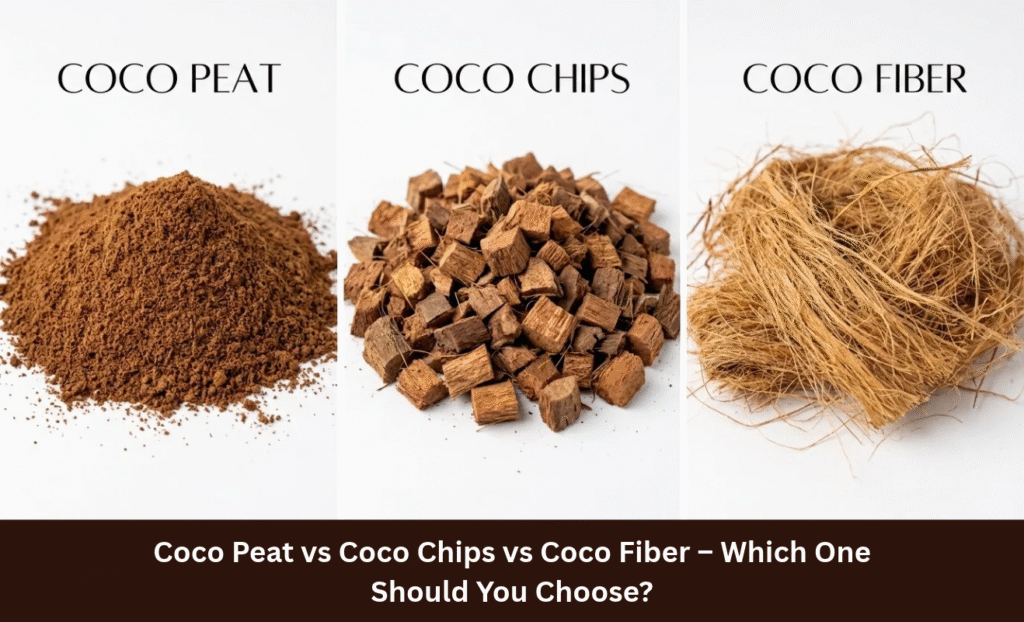
Coco peat vs coco chips is one of the most common questions growers ask when choosing a coco coir substrate. Although both come from the coconut husk, they perform very differently in terms of water retention, aeration, and structure. Understanding these differences helps you select the right material for seed starting, hydroponics, or commercial greenhouse production.
Here’s a clear, practical comparison of coco peat, coco chips, and coco fiber so you can pick the right one for your crop or growing system.
What Exactly Are They?
Coco Peat (also called Coir Pith)
This is the fine, spongy material left after the longer fibers are removed from the husk. It looks and feels a bit like peat moss. Particle size is usually very fine (under 5 mm).
Coco Chips (Husk Chips)
These are coarser pieces of the coconut husk, typically 6–20 mm in size. They are chunky, fibrous, and create larger air pockets.
Coco Fiber (Coir Fiber)
These are the long, stringy fibers extracted from the husk. They are strong and durable, often used more as a structural additive than a primary growing medium.
Coco Peat vs Coco Chips: Key Differences
| Property | Coco Peat | Coco Chips | Coco Fiber |
|---|---|---|---|
| Texture | Fine, soil-like | Chunky, coarse | Long, stringy fibers |
| Water Retention | Very High | Moderate | Low |
| Aeration / Drainage | Moderate to Low | Excellent | Very High |
| Structural Stability | Can compact over time | High (holds structure well) | High |
| Best For | Moisture-loving crops, seed starting, grow bags | Orchids, fruiting crops, blends needing air | Mixing, drainage layers, hanging baskets |
| Longevity | 1–2 seasons | 2–3+ seasons | Long-lasting |
When to Choose Coco Peat vs Coco Chips
Choose coco peat when you need strong moisture retention.
Best uses:
- Seed starting and propagation
- Leafy greens and herbs
- Hydroponic grow bags and slabs
- Soil amendment to improve water-holding capacity
- Crops that dislike drying out between irrigations
Watch out for:
Pure coco peat can hold too much water if irrigation is not managed carefully. Many commercial growers blend it with chips or perlite to improve air porosity.
When Should You Choose Coco Chips?
Coco chips are the best choice when aeration and drainage matter more than maximum water holding.
Best uses:
- Orchids, anthuriums, and other epiphytic plants
- Fruiting crops (tomatoes, cucumbers, peppers) that benefit from dry-backs
- Improving drainage in potting mixes
- Longer crop cycles where structure needs to last
Coco chips create excellent air pockets and resist compaction better than fine peat. They are often mixed with coco peat (for example 70:30 or 50:50 peat-to-chip ratios) to get the best of both worlds.
When Should You Choose Coco Fiber?
Coco fiber is rarely used as a standalone growing medium. Its main value is structural.
Best uses:
- Adding strength and air space to mixes
- Hanging basket liners
- Erosion control and geotextiles
- Drainage layers at the bottom of large containers
- Improving the physical structure of fine substrates
On its own, coco fiber does not hold enough water for most plants.
Which One Is Best Overall?
There is no single winner — it depends on your crop and system:
- Need maximum moisture retention? → Coco Peat
- Need better aeration and longer structure? → Coco Chips or a peat + chips blend
- Need strength or a drainage layer? → Coco Fiber
Most professional greenhouse and hydroponic growers today use blends rather than pure materials. A common approach is:
- Higher peat content for vegetative growth and moisture-loving crops
- Higher chip content for generative (fruiting) stages or crops that prefer faster dry-downs
Quality Matters More Than the Type
Whether you choose peat, chips, or fiber, the quality of processing makes a big difference. Look for:
- Proper washing (low EC)
- Consistent particle size
- Clean material free from excessive dust or contaminants
- Reliable supply for commercial volumes
Manufacturers like NB Coir in Sri Lanka produce all three forms — coco peat, coco chips, and fiber — and can also supply custom blends according to crop requirements. This flexibility is useful when you want a specific peat-to-chip ratio for your greenhouse or nursery operation.
Final Recommendation
Start by asking two simple questions:
- Does my crop prefer steady moisture or periodic dry-backs?
- How important is long-term structure and aeration?
Answer those, and the choice between coco peat, coco chips, and coco fiber becomes much clearer. In many cases, the smartest solution is a well-balanced blend rather than a pure product.