 info@nbcoir.com
 +94

pH Management in Coco Coir – Complete Practical Guide
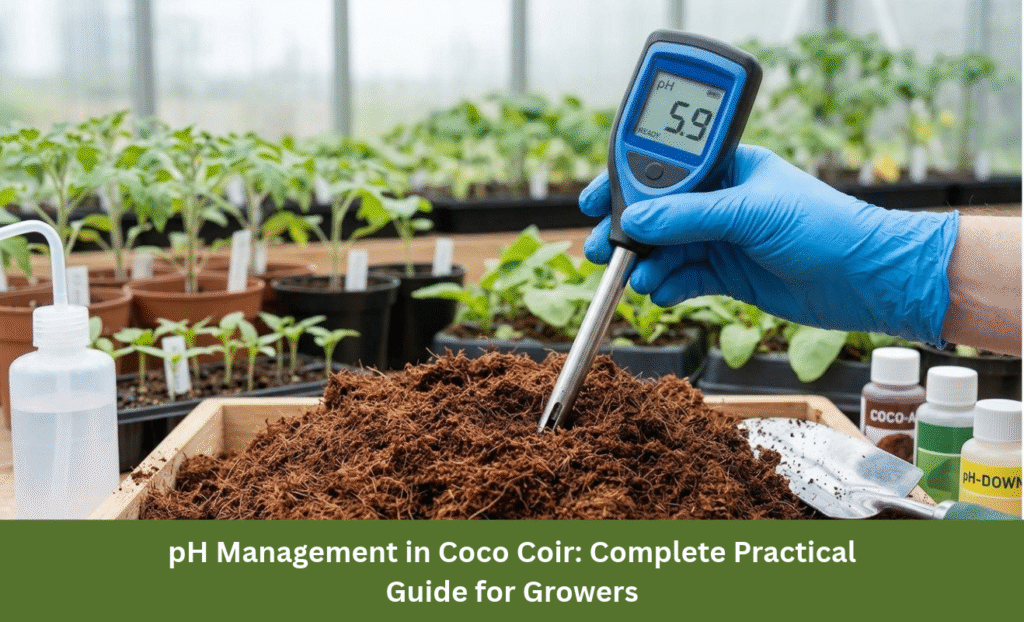
pH management in coco coir is one of the most important skills for successful growing. Even when you use high-quality coco and a balanced nutrient formula, incorrect pH can lock out essential nutrients and slow down plant growth.
This practical guide explains how pH works in coco coir, what range you should target, and how to manage it effectively throughout the crop.
Why pH Management in Coco Coir Matters
Coco coir is a soilless medium with a relatively high cation exchange capacity. This means it can hold and release nutrients, but it also makes the root zone sensitive to pH changes.
When pH drifts too high or too low:
- Nutrient availability drops
- Calcium, magnesium, iron, and other elements can become locked out
- Plants show deficiency symptoms even when nutrients are present in the solution
Maintaining the correct pH helps keep nutrients available and supports steady root and shoot growth.
Ideal pH Range for pH Management in Coco Coir
Most crops grown in coco coir perform best when the root zone pH stays between 5.5 and 6.5.
- Target range for most plants: 5.8 – 6.2
- Acceptable range: 5.5 – 6.5
Staying inside this window gives the best balance of nutrient availability for both macronutrients and micronutrients.
Understanding Input pH vs Runoff pH
There are two important pH readings:
- Input (Feed) pH – The pH of the nutrient solution you apply.
- Runoff (Drain) pH – The pH of the water that comes out of the bottom of the pot or grow bag.
In coco, the runoff pH is often more useful because it reflects what is actually happening in the root zone. Many growers aim for a runoff pH between 5.8 and 6.3.
How to Measure pH Correctly
- Use a reliable digital pH meter (calibrate it regularly).
- Measure both the nutrient solution before feeding and the runoff after irrigation.
- Take readings at consistent times (for example, after the first irrigation of the day).
- Record the values so you can spot trends early.
Never rely only on visual symptoms. By the time leaves show clear problems, the pH may have been off for several days.
Common Causes of pH Drift in Coco
Several factors can push pH up or down:
- Poor quality or inconsistently washed coco
- High alkalinity in source water
- Nutrient formulas that are not balanced for coco
- Infrequent irrigation (allows salts to concentrate)
- Overuse of certain pH adjusters
Buffered and well-washed coco is generally more stable than poorly processed material.
How to Adjust pH in Coco Coir
If pH is too high (above 6.5):
- Use a pH-down product (usually phosphoric or nitric acid based)
- Increase irrigation frequency slightly to encourage more runoff
- Check the alkalinity of your source water
If pH is too low (below 5.5):
- Use a pH-up product (usually potassium hydroxide or potassium carbonate based)
- Avoid over-acidifying the feed solution
- Review your nutrient formula for excess acidic components
Always adjust pH slowly and re-test after mixing.
Best Practices for Stable pH Management
- Start with good-quality, properly washed and preferably buffered coco coir.
- Know your source water (test pH and alkalinity).
- Mix nutrients thoroughly before adjusting pH.
- Aim for consistent irrigation with 10–20% runoff.
- Monitor both input and runoff pH regularly.
- Keep records so you can correct problems early.
- Avoid large, sudden pH swings.
pH Management in Different Growing Systems
- Grow bags and slabs: Runoff pH is especially useful. Aim for consistent drainage.
- Pots and containers: Check moisture and pH more frequently, as smaller volumes change faster.
- Recirculating systems: pH can drift more quickly — monitor daily.
Quality of Coco Makes a Difference
The stability of pH in the root zone is strongly influenced by how the coco was processed. Well-washed and buffered coco peat tends to be more predictable and easier to manage. Poorly processed coco with high residual salts can cause more frequent pH and EC fluctuations.
Manufacturers such as NB Coir focus on producing clean, consistent coco coir that helps growers maintain better control over root zone conditions, including pH.
Final Thoughts
Good pH management in coco coir is not complicated, but it does require consistency. Target a root zone pH between 5.5 and 6.5, measure both input and runoff regularly, and make small corrections when needed.
When pH stays in the right range, plants are able to take up nutrients efficiently, roots stay healthier, and overall growth becomes more predictable. Combined with quality coco and a balanced feeding program, proper pH control is one of the simplest ways to improve crop performance.