 info@nbcoir.com
 +94
+94 
Benefits of Coco Coir: Why Use It as a Growing Medium?
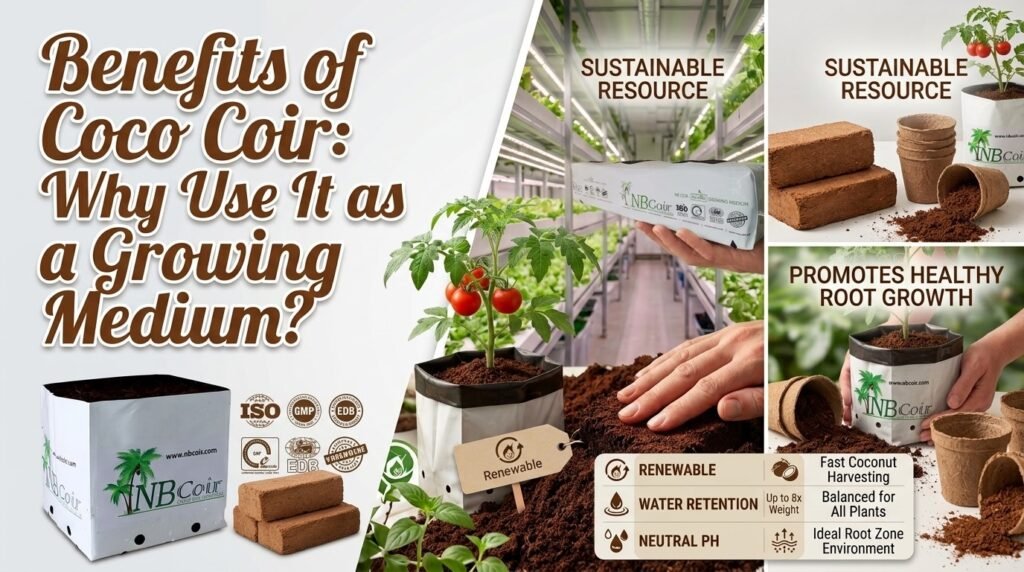
Coco coir is a popular growing medium made from coconut husks. It is widely used in hydroponics, greenhouse cultivation, nurseries, commercial agriculture and home gardening because of its ability to retain moisture while providing good root-zone aeration.
Beyond plant growth, coco coir offers practical and environmental advantages. It makes use of coconut husk material, can be supplied in different formats and specifications, and can be suitable for a wide range of growing systems.
In this guide, we explore the benefits of coco coir and why it is widely used as a growing medium.
What Is Coco Coir?
Coco coir is a natural material obtained from coconut husks. During processing, the husk can be separated into different coir materials, including coco peat, coco chips and coir fiber.
For growing applications, coco peat and coco coir-based products can provide a useful combination of moisture retention, aeration and root support.
Coco coir growing media are available in different forms, including compressed bricks, grow bags, discs, briquettes and customized growing media products.
Benefits of Coco Coir as a Growing Medium
The main benefits of coco coir include moisture retention, root-zone aeration, drainage, easy handling, reusability and its renewable coconut-based source.
1. Excellent Water Retention
One of the major benefits of coco coir is its ability to retain moisture.
Coco coir can absorb and hold water while still allowing air to remain around the roots. This can help create a more balanced root-zone environment when the growing medium is properly prepared and managed.
Good moisture management is particularly important in greenhouse cultivation, nurseries and soilless growing systems where irrigation needs to be carefully controlled.
2. Good Root-Zone Aeration
Healthy roots need both water and oxygen. A growing medium that stays too wet can reduce air availability around the roots.
Coco coir can provide useful pore spaces that support root-zone aeration. This allows growers to maintain a balance between moisture and air around the plant roots.
This characteristic makes coco coir a popular choice for hydroponic and greenhouse growing systems.
3. Good Drainage
In addition to holding moisture, coco coir can support drainage when the product is properly prepared and used with a suitable irrigation system.
The combination of water retention and drainage can help growers manage moisture levels more effectively.
Different coco coir materials, particle sizes and compositions can provide different physical characteristics for specific crops and growing systems.
4. Supports Healthy Root Development
A suitable growing medium should provide plants with physical support while creating a favorable environment around the roots.
Coco coir can provide a lightweight structure that supports root growth while maintaining moisture and air within the root zone.
For commercial growers, selecting the right coco coir specification is important because different crops can have different requirements for moisture, aeration and drainage.
5. Suitable for Hydroponic and Soilless Growing
Coco coir is widely used in hydroponics and soilless cultivation. It can provide physical root support without relying on traditional soil.
Growers can use coco coir in systems such as:
- Greenhouse cultivation
- Hydroponic farming
- Nursery production
- Commercial vegetable growing
- Floriculture
- Seed propagation
- Container growing
For commercial applications, factors such as EC, pH, particle size, expansion and composition should be considered when selecting a coco coir growing medium.
6. Renewable Coconut-Based Material
Coco coir is made from coconut husks, a natural agricultural material generated by the coconut industry.
Using coconut husks for growing media gives this material another useful application and supports the efficient use of agricultural resources.
This renewable source is one reason coco coir is widely considered an attractive option for growers looking for alternatives to traditional growing media.
7. Reusable in Some Growing Applications
Another potential benefit of coco coir is that it can sometimes be reused after a growing cycle.
However, reuse depends on the crop, growing conditions, root health, contamination, salt accumulation and how the material is cleaned and prepared between cycles.
Growers considering reuse should assess the condition of the growing medium before using it for another crop.
8. Available in Different Product Formats
Coco coir can be processed and compressed into different product formats to suit different growing requirements.
Common formats include:
- Coco coir grow bags
- 5KG coco peat bricks
- 25KG coco coir bricks
- Coco coir discs
- Coco peat briquettes
- Custom coco coir growing media
Compressed products can also make storage and transportation more convenient for commercial buyers.
Coco Coir vs Traditional Growing Media
Different growing media have different physical and environmental characteristics. The right choice depends on the crop, growing system and production requirements.
| Feature | Coco Coir | Traditional Soil |
|---|---|---|
| Water Retention | Good to excellent | Varies by soil type |
| Root Aeration | Good when properly prepared | Depends on soil structure |
| Drainage | Good when properly managed | Varies by soil composition |
| Weight | Lightweight when dry | Generally heavier |
| Soilless Growing | Suitable | Not applicable |
| Source | Coconut husks | Natural soil |
Why Is Coco Coir Considered Eco-Friendly?
Coco coir is derived from coconut husks, which are a renewable agricultural resource. Instead of treating the husk only as waste, it can be processed into useful materials for agriculture and horticulture.
This can support a more resource-efficient approach to agricultural production.
However, the overall environmental impact of a growing medium also depends on processing, washing, energy use, transportation, packaging and responsible sourcing.
For this reason, buyers should consider the complete supply chain when evaluating the sustainability of a growing medium.
How Coco Coir Is Used in Commercial Growing
Greenhouse Cultivation
Coco coir is widely used in greenhouse production because it can provide moisture retention and root-zone aeration in controlled growing environments.
Hydroponic Farming
Coco coir can be used as a soilless growing medium for hydroponic crops, providing physical root support and moisture management.
Nurseries
Nurseries can use coco coir for propagation, container growing and the production of young plants.
Commercial Agriculture
Coco coir products can support commercial crop production where consistent growing media specifications are important.
What to Check When Buying Coco Coir
Not all coco coir products have the same physical or chemical characteristics. Commercial buyers should consider the following specifications:
- EC level – important for managing salt levels.
- pH – should be suitable for the intended crop.
- Expansion – important for compressed products.
- Particle size – affects water retention, aeration and drainage.
- Composition – coco peat, chips, fiber or customized ratios.
- Moisture content – affects storage, transport and usable volume.
- Consistency – important for commercial production.
- Packaging – should suit storage and international transportation.
Coco Coir Products for Different Growing Needs
Coco Coir Grow Bags
Coco coir grow bags are suitable for greenhouse, hydroponic and commercial crop production. Different sizes, EC levels and compositions can be selected according to growing requirements.
5KG Coco Peat Bricks
Compressed 5KG coco peat bricks are convenient for storage and transportation and can be expanded with water before use.
25KG Coco Coir Bricks
25KG coco coir bricks are designed for bulk applications and can be supplied with customized compositions and EC specifications.
Coco Coir Discs
Coco coir discs are compact growing media products commonly used for propagation, nurseries and smaller growing applications.
Frequently Asked Questions
What are the main benefits of coco coir?
The main benefits of coco coir include moisture retention, root-zone aeration, drainage, root support, versatility and its renewable coconut-based source.
Is coco coir good for plants?
Yes. Coco coir can provide a suitable growing environment for many plants when the product is properly prepared and matched to the crop’s requirements.
Is coco coir good for hydroponics?
Yes. Coco coir is widely used in hydroponic and soilless growing systems because it can provide moisture retention, aeration, drainage and physical root support.
Can coco coir be reused?
Coco coir can sometimes be reused, depending on the crop, growing conditions, contamination, salt accumulation and how the material is cleaned and prepared between growing cycles.
Is coco coir environmentally friendly?
Coco coir is made from coconut husks, a renewable agricultural resource. Its environmental benefits depend on responsible sourcing, processing, transportation, packaging and overall supply-chain practices.
What should I consider when buying coco coir?
Consider EC, pH, expansion, particle size, moisture content, composition, consistency, packaging and the requirements of your crop and growing system.
Conclusion
The benefits of coco coir make it a versatile growing medium for modern horticulture. Its ability to retain moisture while supporting root-zone aeration and drainage makes it suitable for hydroponics, greenhouse cultivation, nurseries and commercial agriculture.
Its coconut-based source, range of product formats and potential for reuse in suitable applications also make coco coir an attractive option for growers looking for practical and more resource-efficient growing media.
For commercial growers and agricultural businesses, choosing the right coco coir specification is essential. EC, pH, particle size, expansion, composition and consistency should all be considered before placing an order.
NB Coir manufactures and exports coco peat and coco coir growing media from Sri Lanka, with customized specifications available for commercial growers, distributors, nurseries and hydroponic businesses.