 info@nbcoir.com
 +94
+94 
Coco Peat vs Peat Moss: Which Is Better for Sustainable Growing?
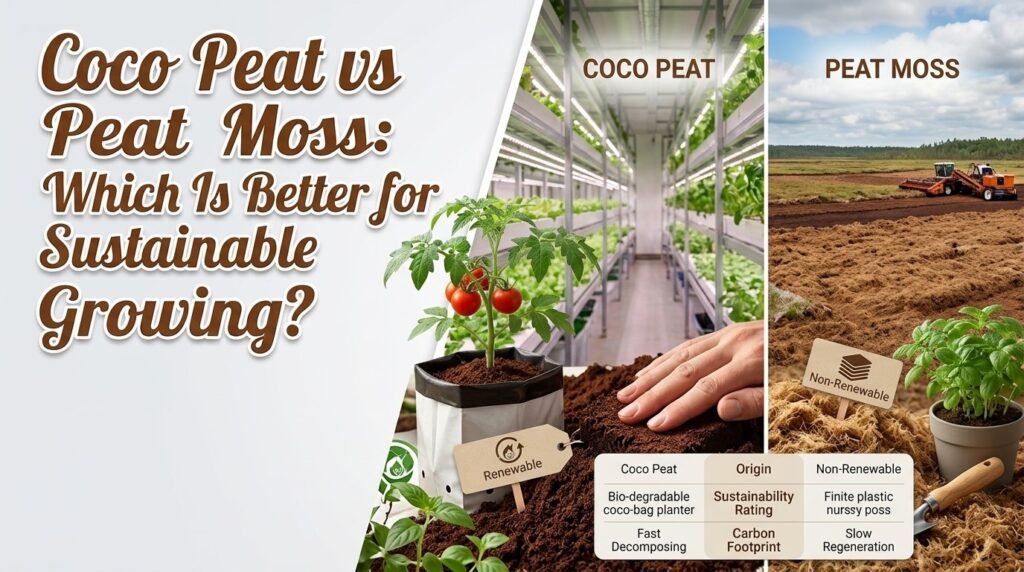
When you’re choosing a growing medium, two names come up again and again: coco peat and peat moss. Both hold water well and can grow healthy plants, but they come from very different places and have different long-term effects.
This post looks at the practical differences — water behaviour, pH, environmental impact, cost, and where each one actually works best — so you can decide which suits your system.
What Is Coco Peat?
Coco peat is the fine material that comes from coconut husks. After the coconut is harvested, the thick husk is processed and the soft, peat-like part is separated out. It’s essentially a by-product of the coconut industry that has found a useful second life as a growing medium.
You’ll see it used in hydroponics, greenhouses, nurseries, commercial vegetable production, flower growing, seed starting, and home gardening. It holds moisture while still leaving air spaces for roots, which is why so many growers like it.
It comes in different forms: compressed 5kg or 25kg bricks, grow bags, briquettes, discs, and loose mixes.
What Is Peat Moss?
Peat moss is formed from partially decomposed plant material that has built up in peat bogs over hundreds or thousands of years. It has been a standard ingredient in potting mixes and seed-starting media for a long time because it is light and holds water well.
Common uses include potting mixes, seed starting, container plants, nursery production, and general soil improvement.
The main concern with peat moss is how it is extracted and the time it takes to form.
Coco Peat vs Peat Moss: Key Differences
| Feature | Coco Peat | Peat Moss |
|---|---|---|
| Source | Coconut husks | Partially decomposed plant material from peatlands |
| Water Retention | Excellent | Excellent |
| Root Aeration | Good | Moderate to good |
| Drainage | Good when properly prepared | Can retain significant moisture |
| Typical pH | Generally around 5.5–6.5 | Generally acidic, often around 3.5–4.5 |
| Renewability | Renewable agricultural by-product | Forms extremely slowly |
| Environmental Impact | Makes use of coconut husk material | Peat extraction can affect peatland ecosystems |
| Consistency | Available in controlled specifications | Can vary depending on source |
| Customization | EC, composition and particle size can be specified | More limited |
| Transportation | Often compressed for efficient shipping | Also commonly compressed |
| Common Uses | Hydroponics, greenhouses, nurseries, commercial growing | Potting mixes, seed starting, horticulture |
Water Retention: Coco Peat vs Peat Moss
Both materials hold a lot of water. The practical difference is how they balance that water with air around the roots.
Coco peat, when the structure is good, keeps moisture available while still allowing air movement. That makes it especially useful in systems where irrigation is controlled, such as hydroponics and greenhouses.
Peat moss also holds water very well, but it can sometimes stay wetter for longer. Many growers mix it with other materials (perlite, bark, etc.) to improve aeration and drainage.
pH: Which Is Better?
Coco peat and peat moss generally have different natural pH characteristics.
Coco peat is typically mildly acidic and can be processed according to the requirements of different growing applications.
Peat moss is naturally more acidic.
The ideal pH depends on the crop being grown. Instead of choosing a growing medium based only on its natural pH, commercial growers should consider the crop requirements and the specifications of the final growing medium.
Coco peat products can also be supplied with different processing and EC specifications depending on the intended application.
Environmental Impact
Environmental sustainability is one of the biggest differences between coco peat and peat moss.
Coco Peat
Coco peat is produced from coconut husks, which are generated by the coconut industry. Using this material for growing media gives another useful application to a renewable agricultural resource.
When responsibly processed, coco peat can support a more circular approach to agricultural materials.
Peat Moss
Peatlands are ecosystems that accumulate organic matter over very long periods. Peat extraction can disturb these ecosystems and release stored carbon.
Because peat forms extremely slowly, it is generally considered a non-renewable resource on human timescales.
For growers looking for alternatives to peat-based growing media, coco peat is one widely used option.
Cost: Coco Peat vs Peat Moss
The cost of coco peat and peat moss can vary significantly depending on:
- Product quality
- Processing
- Moisture content
- Transportation
- Packaging
- Order quantity
- Country of destination
- Product specifications
Coco peat is often supplied in compressed blocks, bricks, grow bags, briquettes and discs, which can make transportation and storage more efficient.
For commercial buyers, it is important to compare the delivered cost and usable volume after expansion, rather than simply comparing the price of one compressed package with another.
Which Is Better for Hydroponics?
Coco peat is widely used in hydroponic and soilless growing systems because it can provide a balance of:
- Moisture retention
- Root-zone aeration
- Drainage
- Root support
Coco peat can also be combined with coco chips or other materials to create different physical characteristics for specific crops and growing systems.
For commercial hydroponic growers, specifications such as EC, pH, expansion, particle size and peat-to-chip ratio can be important when selecting a product.
Learn more about our Coco Coir Grow Bags for greenhouse and hydroponic cultivation.
Which Is Better for Sustainable Growing?
If sustainability is a major consideration, coco peat can be an attractive alternative to peat moss because it is made from coconut husks, a renewable agricultural material.
However, sustainability does not depend only on the material itself. Processing methods, washing, energy use, transportation, packaging and responsible sourcing also matter.
For this reason, buyers should evaluate the complete supply chain when selecting a growing medium.
Coco Peat for Commercial Growing
Coco peat is available in different product formats to suit different growing requirements.
5KG Coco Peat Bricks
Compressed coco peat bricks are convenient for storage and transportation and expand after hydration.
Coco Coir Grow Bags
Grow bags are designed for greenhouse, hydroponic and commercial crop production and can be supplied in different sizes and compositions.
25KG Coco Coir Bricks
Larger compressed bricks are suitable for bulk buyers, commercial growers and distributors requiring larger quantities of growing media.
Coco Coir Discs
Compressed coco coir discs are commonly used for propagation, nurseries and smaller growing applications.
How to Choose Between Coco Peat and Peat Moss
1. Crop Requirements
- Different plants have different requirements for moisture, aeration, drainage, pH and EC.
2. Environmental Priorities
- If reducing dependence on peat-based materials is important, coco peat can be considered as an alternative.
3. Growing System
- Hydroponic, greenhouse, nursery and container applications may require different physical characteristics.
4. Product Specifications
- Check EC, pH, expansion, particle size, composition and consistency before selecting a growing medium.
5. Total Delivered Cost
- For commercial purchases, consider shipping, compression, expansion, packaging and usable volume.
Frequently Asked Questions
Is coco peat better than peat moss?
Coco peat can be a strong alternative to peat moss, particularly for growers looking for a renewable coconut-based growing medium. The better option depends on the crop, growing system, product specifications and environmental priorities.
Is coco peat more sustainable than peat moss?
Coco peat is made from coconut husks, while peat moss comes from peatlands that form extremely slowly. For this reason, coco peat is commonly considered a more renewable growing medium option.
Can coco peat replace peat moss?
Yes. Coco peat can be used as an alternative to peat moss in many horticultural and soilless growing applications. However, the product should be selected according to the crop’s requirements for water retention, aeration, pH, EC and drainage.
Is coco peat good for hydroponics?
Yes. Coco peat is widely used in hydroponic and soilless cultivation because it can provide moisture retention, root support, aeration and drainage.
Does coco peat need to be washed?
Some coco peat products are washed or buffered to achieve specific EC levels. The required processing depends on the intended application and crop requirements.
What should I check when buying coco peat?
For commercial applications, check EC, pH, expansion, moisture, particle size, composition, compression, packaging and consistency. Buyers should also confirm whether the product can be customized to their requirements.
Conclusion: Coco Peat or Peat Moss?
Both coco peat and peat moss have useful characteristics for growing plants. However, they differ significantly in their sources and environmental considerations.
Coco peat offers a renewable, coconut-based alternative with excellent moisture retention, good aeration and applications across hydroponics, greenhouses, nurseries and commercial agriculture.
For growers and businesses looking for a more sustainable growing medium, coco peat is worth considering as an alternative to traditional peat-based products.
NB Coir manufactures and exports customized coco peat and coco coir products from Sri Lanka for commercial growers, distributors, nurseries, hydroponic farms and agricultural businesses worldwide.