 info@nbcoir.com
 +94
+94 
Coco Peat EC: 5 Key Facts About Low EC Growing Media
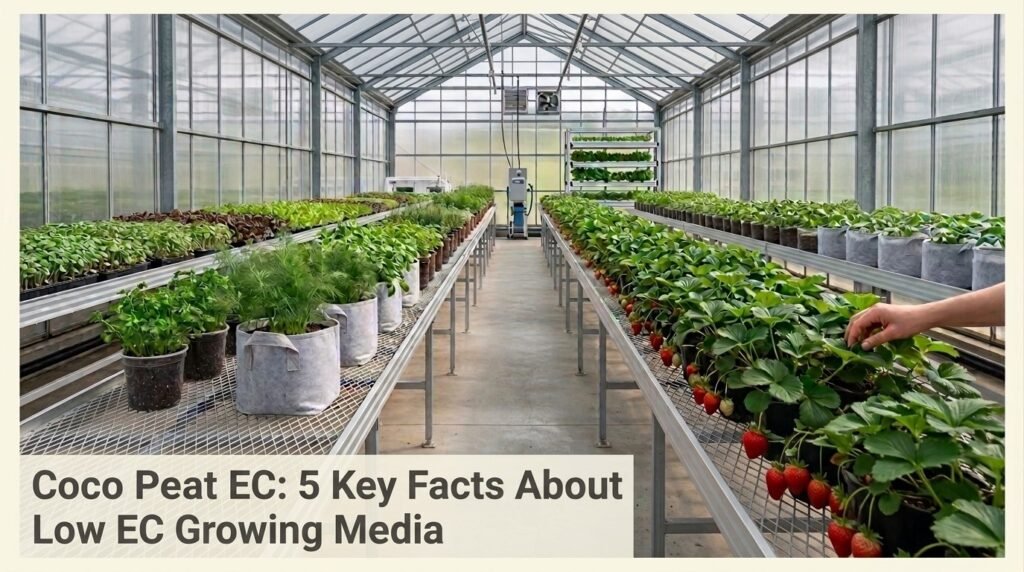
When choosing coco peat for plant production, EC is one of the most important specifications to understand. EC, or electrical conductivity, indicates the level of soluble salts present in a growing medium or its extract.
For hydroponic growers, greenhouse operators, nurseries and commercial farms, managing EC is important because excessive soluble salts can affect how plants absorb water and nutrients.
In this guide, we explain coco peat EC levels, the difference between low and high EC coco peat, how EC can affect plants, and why choosing a suitable EC specification matters for commercial growing.
What Is EC in Coco Peat?
EC stands for electrical conductivity. It is a measurement commonly used to indicate the concentration of soluble salts in a growing medium or nutrient solution.
In coco peat, EC can be influenced by naturally occurring salts and the processing and washing of the coconut husk material.
A higher EC generally indicates a higher concentration of soluble salts, while a lower EC indicates a lower concentration of soluble salts.
Because plants are sensitive to the concentration of salts around their roots, understanding the EC of coco peat is important when selecting a growing medium.
Why Does Coco Peat EC Matter?
The growing medium directly surrounds the plant’s root system. This means the chemical characteristics of the medium can influence the root-zone environment.
If the soluble salt level is too high for a particular crop or growing system, it can make water uptake more difficult for plants and may interfere with nutrient management.
For this reason, commercial growers often consider EC alongside other specifications such as pH, moisture, particle size, expansion and composition.
Low EC vs High EC Coco Peat
| Feature | Low EC Coco Peat | High EC Coco Peat |
|---|---|---|
| EC Level | ≤ 0.5 mS/cm | > 0.8 – 1.0 mS/cm (often 1.5–3.0+) |
| Processing | Thoroughly washed and buffered | Minimally washed or unwashed |
| Salt Content | Very low | High |
| Plant Safety | High (safe even for sensitive crops) | Limited / Risky |
| Nutrient Control | Very easy | Difficult |
| Root Development | Excellent | Risky |
| Best Uses | Hydroponics, Nursery, Greenhouse, Sensitive crops | Soil amendment, Landscaping, Animal bedding |
| Price | Higher | Lower |
| Ready to use? | Yes | Often requires additional processing |
| Long-term ROI | High | Lower (due to risks) |
Low EC Coco Peat Can Help With Root-Zone Management
Low EC coco peat contains a lower concentration of soluble salts, which can give growers greater control over the starting conditions of the growing medium.
This can be particularly useful when growers want to manage nutrients through their own irrigation and fertigation programs.
For commercial production, starting with a suitable EC level can make it easier to develop a consistent root-zone management strategy.
High EC Coco Peat Requires Careful Management
High EC coco peat contains a higher concentration of soluble salts. This does not automatically mean that the product is unsuitable for plants.
The appropriate EC depends on the crop, growing system, irrigation method and overall nutrient management program.
However, when using higher EC coco peat, growers may need to pay closer attention to the root-zone salt concentration and irrigation strategy.
EC Can Affect Plant Water Uptake
The concentration of dissolved salts around plant roots can influence the movement of water into the root system.
When soluble salt concentrations become too high, plants may have more difficulty taking up water. This can place additional stress on plants, particularly when environmental conditions increase water demand.
Managing the EC of the growing medium and irrigation solution is therefore an important part of maintaining suitable root-zone conditions.
Low EC Coco Peat Is Useful for Controlled Growing Systems
Hydroponic and greenhouse growers often have precise nutrient and irrigation programs. For these systems, the starting characteristics of the growing medium are important.
Low EC coco peat can provide a suitable starting point for growers who want to manage nutrient levels through their own fertigation systems.
This is one reason EC is an important specification when selecting coco peat for commercial hydroponic and greenhouse production.
Learn more about our Coco Coir Grow Bags designed for greenhouse and hydroponic growing applications.
EC Should Be Considered Together With Other Specifications
EC is important, but it should not be the only specification considered when purchasing coco peat.
Commercial buyers should also evaluate:
- pH – important for maintaining a suitable root-zone environment.
- Expansion – indicates the usable volume obtained after hydration.
- Particle Size – affects water retention, aeration and drainage.
- Composition – may include coco peat, coco chips or customized ratios.
- Moisture Content – important for storage, transport and product handling.
- Consistency – important for uniform commercial production.
Why Low EC Matters for Hydroponics
Hydroponic systems allow growers to control water and nutrient delivery very precisely. Because of this, the characteristics of the growing medium can have an important role in the overall root-zone environment.
Low EC coco peat can be useful when growers want a lower starting salt level and greater control over the nutrients supplied through irrigation.
However, the ideal EC specification should always be selected according to the crop and the grower’s production system.
Why NB Coir Focuses on Controlled EC Options
At NB Coir, coco peat products are manufactured with different EC specifications to meet the requirements of commercial growers and international buyers.
Depending on the product and customer requirements, coco peat can be supplied with low EC, high EC or customized EC specifications.
This allows buyers to select a growing medium according to their crop, irrigation system and intended application.
For commercial orders, EC can be considered together with product composition, expansion, particle size, packaging and other technical requirements.
Low EC Coco Peat for Commercial Growing
Low EC coco peat can be suitable for a wide range of commercial growing applications, including:
- Hydroponic farming
- Greenhouse cultivation
- Commercial vegetable production
- Nursery production
- Plant propagation
- Floriculture
- Soilless growing systems
The correct product specification depends on the crop, production method and nutrient management program.
Available Coco Peat Products
5KG Coco Peat Bricks
Compressed 5KG coco peat bricks are available with different EC specifications and can be used for hydroponics, greenhouses, nurseries and commercial agriculture.
Coco Coir Grow Bags
Coco coir grow bags can be supplied in different sizes, compositions and EC levels for greenhouse and hydroponic crop production.
25KG Coco Coir Bricks
25KG coco coir bricks are suitable for bulk applications and can be supplied with customized EC and composition requirements.
Coco Coir Discs
Coco coir discs are compressed growing media products available in different sizes and EC options for propagation and nursery applications.
How to Choose the Right Coco Peat EC
There is no single EC level that is ideal for every crop or growing system. When selecting coco peat, consider the following factors:
Crop Requirements
Different crops have different tolerance levels and nutrient requirements. Select a growing medium that matches the crop and production stage.
Growing System
Hydroponic, greenhouse, nursery and container systems can have different requirements for EC and nutrient management.
Irrigation and Fertigation
Consider how nutrients will be delivered to the plants and how the root-zone EC will be managed throughout the growing cycle.
Product Composition
Coco peat can be supplied as a fine growing medium or combined with materials such as coco chips to achieve different physical characteristics.
Supplier Specifications
Always request clear technical specifications from the supplier, including EC, pH, expansion, moisture and composition.
Frequently Asked Questions About Coco Peat EC
What does EC mean in coco peat?
EC means electrical conductivity. It is commonly used to indicate the concentration of soluble salts in coco peat or its extract.
What is low EC coco peat?
Low EC coco peat has a lower concentration of soluble salts and can be useful for growing systems where growers want greater control over the starting salt level of the growing medium.
Is low EC coco peat better for hydroponics?
Low EC coco peat can be suitable for hydroponic systems because it provides a lower starting salt level, allowing growers to manage nutrients through their irrigation and fertigation programs.
Is high EC coco peat bad for plants?
Not necessarily. High EC coco peat can be suitable for certain applications, but the appropriate EC depends on the crop, growing system and nutrient management strategy.
What other specifications should I check besides EC?
Commercial buyers should also check pH, expansion, particle size, moisture content, composition and consistency before selecting coco peat.
Can coco peat EC be customized?
Depending on the product and manufacturing requirements, coco peat can be supplied with different EC specifications, including low, high or customized EC options.
Conclusion
Understanding coco peat EC is important when selecting a growing medium for hydroponics, greenhouse cultivation, nurseries and commercial agriculture.
Low EC coco peat can provide growers with a lower starting salt level and greater control over nutrient management, while higher EC products may be suitable for specific applications when properly managed.
EC should always be considered together with pH, expansion, particle size, composition and the requirements of the crop.
NB Coir manufactures and exports coco peat and coco coir products from Sri Lanka with low EC, high EC and customized specifications available for commercial growers, distributors and international buyers.
Looking for coco peat with a specific EC level? Contact NB Coir to discuss your crop requirements, product specifications, packaging and bulk export needs.