 info@nbcoir.com
 +94
What Is Coco Peat? Coco Coir Guide for Beginners
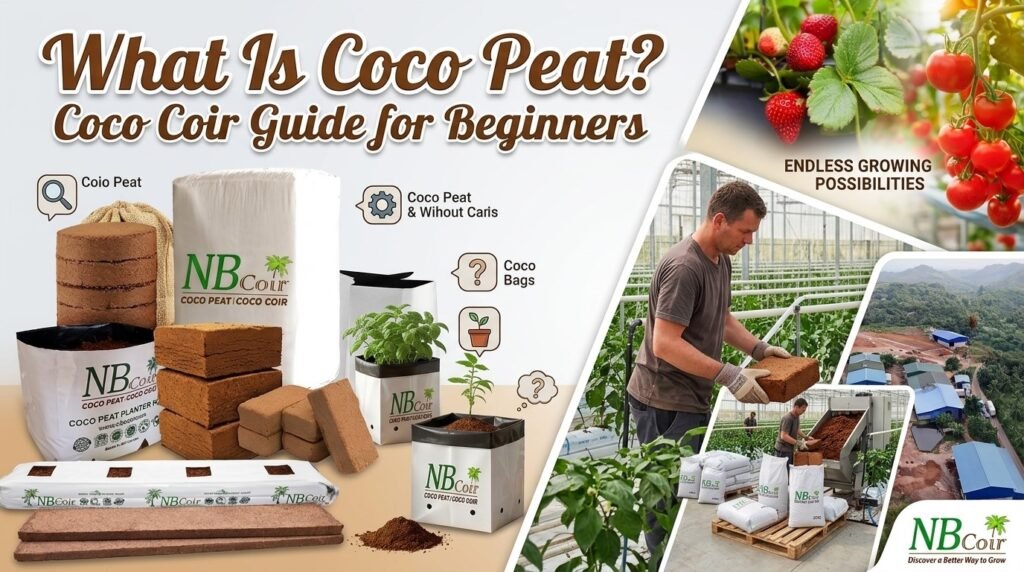
If you’re just getting into gardening, greenhouse growing, or hydroponics, you’ve probably come across the terms coco peat and coco coir. They appear on product bags, in grower forums, and in supplier catalogs. A lot of people use the two names as if they mean exactly the same thing. In reality there is a small but useful difference.
This guide explains what is coco peat actually, how it is made, how it differs from coco coir, why growers use it, and what you should look for when buying it.
What Is Coco Peat?
Coco peat is the fine, peat-like material that comes from coconut husks. When a coconut is harvested, the thick fibrous husk that surrounds the shell is the raw material. During processing, this husk is broken down and separated into different parts. The finest material becomes coco peat. The coarser pieces become coco chips or longer coir fibres.
Because of its structure, coco peat can hold a good amount of water while still leaving air spaces around the roots. That balance is the main reason it became popular as a growing medium.
Coco peat is used in a variety of growing systems, including:
🌱 Greenhouse cultivation
💧 Hydroponic farming
🌿 Nurseries
🥬 Commercial agriculture
🌸 Floriculture
🪴 Home gardening
🌾 Soilless growing systems
How is Coco Peat Made?
The process is relatively straightforward, though the quality depends heavily on how carefully each step is handled.
1. Collecting the husks
Fresh or dried coconut husks are gathered. The quality of the raw husk affects the final product, so better processors are selective at this stage.
2. Processing the husk
The husks are mechanically broken down. This separates the material into fine peat, chips, and longer fibres.
3. Screening
The fine material is screened to achieve a more uniform particle size. Too many very fine particles can cause the medium to compact later.
4. Washing and EC control
Raw coco peat often contains natural salts (mainly potassium and sodium). For many crops, especially in hydroponics, these salts need to be reduced. This is done through washing. The level of washing determines the final EC (electrical conductivity). Some material is only lightly washed, while other batches are washed more thoroughly to reach low EC levels.
5. Drying and compression
After processing, the material is dried and then compressed into different forms — 5kg bricks, 25kg bricks, briquettes, grow bags, discs, or loose bales — depending on what the buyer needs.
Why Is Coco Peat Made From Coconut Husk?
Coconut husk is a natural coir resource that can be processed into useful agricultural materials.
Instead of treating the husk simply as waste, different components can be processed and used for growing media, fibre products, and other applications.
This makes coco-based products useful across both agriculture and other industries.
What Is the Difference Between Coco Peat and Coco Coir?
This is one of the most common questions for people who are new to coco-based growing media.
Although the terms Coco Peat and Coco Coir are sometimes used interchangeably, they do not always refer to exactly the same material.
Coco Peat
Coco peat is the fine, peat-like material obtained from processing coconut husks.
It is commonly used as a growing medium or as a component of growing media mixes.
Typical applications include:
Moisture management
Seed propagation
Greenhouse cultivation
Hydroponic growing
Nursery production
Soilless cultivation
Coco Coir
Coco coir is a broader term used for coir-based materials obtained from coconut husks.
Depending on the context, this can include:
Coco peat
Coco chips
Coir fibre
Products made from these materials
For example, Coco Coir Grow Bags and Coco Coir Planter Bags are commercial products made using coco-based growing media.
A simple way to remember it:
- Coco Peat = Fine growing-medium material
- Coco Coir = Broader category of coconut-husk coir materials and products
So, while coco peat is a type of coco-based material, Coco Coir is the broader term.
Key Benefits of Coco Peat
Why has coco peat become such a popular growing medium?
Here are some of its main benefits.
💧 Good Water Retention
Coco peat can retain moisture and help support efficient water management around plant roots.
This can be particularly useful in controlled growing systems where irrigation needs to be managed carefully
🌬️ Root-Zone Aeration
A suitable coco peat structure can help maintain air spaces around plant roots.
Good aeration is important for healthy root-zone conditions.
🚿 Balanced Drainage
Coco peat can retain moisture while also allowing excess water to drain.
The balance between water retention and drainage is an important characteristic of a growing medium.
🌱 Suitable for Soilless Growing
Coco peat can be used as a growing medium or as part of a growing media mix in suitable soilless cultivation systems.
It is therefore commonly used in greenhouse and hydroponic growing.
♻️ Coconut-Based Natural Material
Because coco peat is derived from coconut husks, it provides a way to use a natural coir resource for agricultural applications.
Where Is Coco Peat Used?
Coco peat can be used across different cultivation environments.
🌿 Greenhouse Cultivation
Coco-based growing media can be used for crop production in controlled greenhouse environments.
For commercial greenhouse growers, products can be selected according to crop, irrigation system, EC requirements, and other specifications.
💧 Hydroponic Farming
Coco peat and coco chips can be used as growing media in suitable soilless and hydroponic systems.
For larger commercial operations, products such as 25KG Coco Coir Bricks can provide a compressed format for bulk applications.
🌱 Nurseries
Coco-based growing media can be used for seedlings, young plants, propagation, and nursery production.
For propagation applications, compact products such as Coco Coir Discs can also be used.
🥬 Commercial Agriculture
Commercial growers can use customized coco peat products and growing media mixes according to their crop and cultivation requirements.
🌸 Floriculture
Coco-based growing media can also be used for flowers and ornamental plants.
Why Is Coco Peat a Good Growing Medium for Plants?
When choosing a growing medium, there is no single characteristic that determines whether it is suitable.
A good growing medium needs to support several important conditions:
Water + Air + Drainage + Root Support
Coco peat, when processed to suitable specifications, can help provide a balance between moisture retention and root-zone aeration.
This is one reason coco-based growing media are used by greenhouse growers, nurseries, hydroponic growers, and other commercial cultivation operations.
However, the most suitable coco peat specification depends on the crop, growing system, irrigation method, and required EC and composition.
What Should You Look for When Buying Coco Peat?
The word “premium” on a bag does not tell you much. What matters are the actual specifications:
- EC level – Especially important for hydroponics and salt-sensitive crops. Ask whether it is low EC, and how it was washed.
- pH range – Most good coco peat falls between roughly 5.5 and 6.5.
- Composition – Pure coco peat, peat mixed with chips, or a custom ratio.
- Particle size and structure – Too much fine dust can lead to compaction over time.
- Expansion – For compressed bricks, how many litres you get after hydration.
- Consistency – Whether different batches behave the same way.
- Packaging and loadability – Important if you are importing or ordering in bulk.
- Customization options – Can the supplier adjust EC, mix, size, or packaging?
Coco Peat Products
Coco peat and coco coir materials can be supplied in different formats depending on the application.
These can include:
If you are looking for a wider range of products, you can explore NB Coir’s Coco Peat and Coco Coir Products.
This is a good place to put an internal link because the reader has now learned what coco peat is and may want to see actual products.
Frequently Asked Questions
Is Coco Peat the Same as Coco Coir?
Not exactly.
Coco peat refers to the fine, peat-like material obtained from processing coconut husks, while coco coir is a broader term for coconut-husk-based coir materials and products.
Is Coco Peat Made From Coconut Husks?
Yes. Coco peat is obtained by processing coconut husks and separating the fine, peat-like coir material.
Is Coco Peat Good for Plants?
Coco peat with suitable quality and specifications can be used as a growing medium to support moisture retention, drainage, and root-zone aeration.
Can Coco Peat Be Used for Hydroponics?
Yes. Coco peat and other coco-based growing media can be used in suitable hydroponic and soilless cultivation systems.
However, the product’s EC, composition, and other specifications should be appropriate for the crop and growing system.
What Products Can Be Made From Coco Peat?
Coco peat can be processed and compressed into different formats, including bricks, blocks, briquettes, grow bags, and other customized growing media products.
Conclusion
Coco peat is simply a useful, renewable growing medium made from coconut husks. Its value comes from the physical properties water holding, aeration, and consistency rather than from any significant nutrient content. When the material is processed properly and matched to the crop and system, it performs reliably for both small growers and large commercial operations.
The most important thing is not the marketing description, but the actual specifications: EC, structure, composition, and consistency. Getting those right makes a noticeable difference in how the medium behaves in the root zone.