 info@nbcoir.com
 +94
+94 
Low EC vs High EC Coco Peat: Which One Should You Choose?
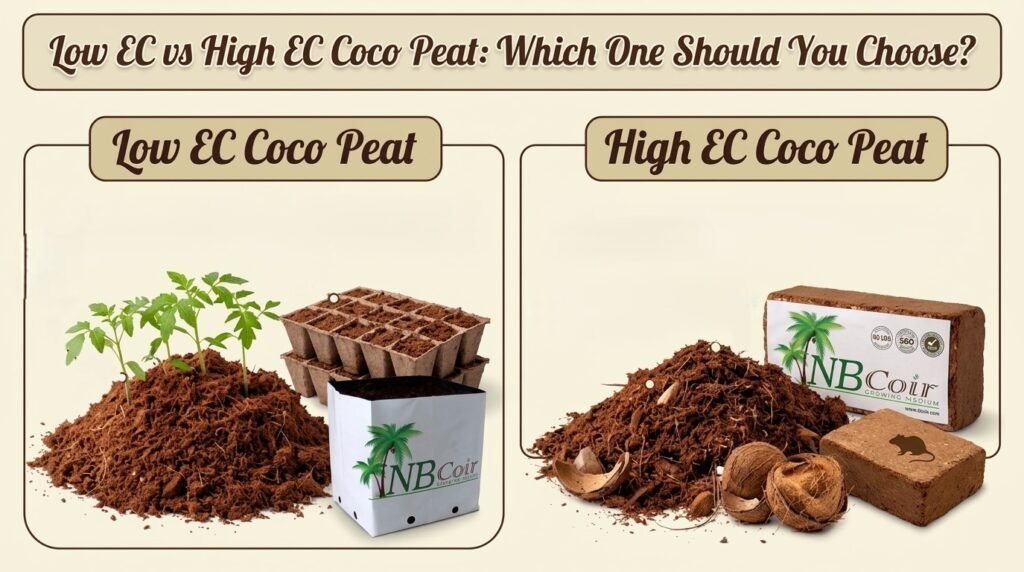
When comparing Low EC vs High EC Coco Peat, most buyers are not aware of EC (Electrical Conductivity) when purchasing coco peat at a commercial or indoor level. But the EC level is the main factor that directly impacts plant root health, nutrient absorption, growth rate, and the final yield.
Especially in hydroponics, greenhouses, nurseries, and commercial vegetable/flower gardens, choosing the wrong option in Low EC vs High EC Coco Peat can cause serious problems like root burn, nutrient blockages, uneven growth, and reduced yield. In this blog, you will clearly understand the difference between Low EC vs High EC Coco Peat, their advantages, risks, and how to choose the best one according to your needs.
What is the EC in Coco Peat?
First, we will understand what EC means. Electrical Conductivity is the expanded meaning of EC. It measures the soluble salts, including Sodium (Na), potassium (K), and Chlorides (Cl), in the coco peat. The measurement unit of EC is mS/cm (milliSiemens per centimetre). If the EC value is high, it means the salt content is high; if not, the salt content is low.
Naturally, coconut trees grow near the seawater. Therefore, coconut husks absorb salt. If the husks are not washed properly during processing, the salts remain in the coco peat.
If there is a high EC, the following things may happen:
- Osmotic stress occurs in plant roots (making water absorption difficult)
- Root burn may occur
- Uptake of essential nutrients like calcium and magnesium may be blocked (nutrient lockout)
- Plant growth slows down
- Crop yield decreases
Therefore, commercial growers must understand the EC level of the coco peat before deciding between Low EC vs High EC Coco Peat.
What is the Low EC Coco Peat?
Low EC Coco Peat is the coco peat that has been thoroughly washed multiple times and buffered to remove salts. During the buffering process, calcium and magnesium are added to replace sodium and potassium, creating a more stable environment for the plants.
Main features of Low EC Coco Peat:
- EC value is generally 0.5 mS/cm or less (sometimes considered up to 0.6)
- pH value between 5.5–6.8
- Very low sodium and potassium
- Easy to control nutrition
- Highly beneficial for early root development
Best uses of Low EC Coco Peat:
- Hydroponics and soilless farming
- Seedlings and nurseries
- Vegetables (tomatoes, eggplants, cabbage, lettuce)
- Berries (strawberries, blueberries)
- Flowers and ornamental plants
- Cannabis and medicinal plants
- Greenhouse and commercial cultivation
- Any situation requiring precise nutrient control
Main advantages of Low EC Coco Peat:
- Minimal risk of root damage
- High nutrient absorption
- Uniform and consistent growth
- High success rate during the early growth stage
- Precise control over fertilizer formulations
- Delivers higher long-term returns (ROI)
- Meets export quality standards
What is High EC Coco Peat?
High EC coco peat is coco peat that has been minimally washed or remains completely unwashed. Natural salt levels within it remain high.
Main features of High EC Coco Peat:
- EC value is generally above 0.8 mS/cm (often 1.5 – 3.0 or higher)
- High salt content
- Lower cost (due to minimal processing)
- Good water retention capacity
Best uses of High EC Coco Peat:
- Soil amendment
- Mulching and landscaping
- Salt-tolerant plants
- Animal bedding and pet bedding
- Compost mixtures
- Improving soil structure in open fields
Disadvantages and risks of High EC Coco Peat:
- Harmful to sensitive plants
- Unsuitable for hydroponics and nurseries
- High risk of root burn
- Potential for nutrient lockout
- May require additional leaching or buffering (extra cost)
Comparison of low-EC vs High EC
| Feature | Low EC Coco Peat | High EC Coco Peat |
|---|---|---|
| EC Level | ≤ 0.5 mS/cm | > 0.8 – 1.0 mS/cm (often 1.5–3.0+) |
| Processing | Thoroughly washed and buffered | Minimally washed or unwashed |
| Salt Content | Very low | High |
| Plant Safety | High (safe even for sensitive crops) | Limited / Risky |
| Nutrient Control | Very easy | Difficult |
| Root Development | Excellent | Risky |
| Best Uses | Hydroponics, Nursery, Greenhouse, Sensitive crops | Soil amendment, Landscaping, Animal bedding |
| Price | Higher | Lower |
| Ready to use? | Yes | Often requires additional processing |
| Long-term ROI | High | Lower (due to risks) |
Which one do you need to choose?
Choose Low EC Coco Peat if:
- You are engaged in hydroponics or greenhouse cultivation
- You are dealing with young plants or nursery operations
- You are growing vegetables, berries, flowers, or sensitive crops
- Precise nutrient control is required
- Quality, consistency, and yield are important
- You aim for export-quality produce
Choose High EC Coco Peat if:
- You are using it solely for soil improvement in open fields
- You are growing salt-tolerant plants
- You are using it for animal bedding or mulching
- Keeping costs very low is a priority
- You can wash and buffer it yourself
Important Things to Consider When Purchasing
- Request a recent lab report (including EC and pH values)
- Inquire whether it has been buffered (washing alone may not be sufficient)
- Check the moisture content, fiber content, and impurity levels
- If sourcing from a new supplier, test a small quantity first
- For commercial purchases, consistency in quality is more important than price
- Ask about batch-to-batch consistency
Frequently Asked Questions (FAQ)
What should the EC value of Low EC coco peat be?
A value of 0.5 mS/cm or lower is recommended for professional growers. Some suppliers accept values up to 0.6. Anything above 0.8 cannot be considered Low EC.
Can I wash High EC coco peat myself to make it Low EC?
Yes, you can. However, this requires clean water, time, labor, and a buffering process. On a commercial scale, this may not be cost-effective. Often, it is better to purchase Low EC coco peat directly.
Does Low EC coco peat contain nutrients?
No. Low EC coco peat is an inert medium; its nutrient content is very low. This allows you to add and precisely control fertilizers, which is a major advantage in hydroponics.
What EC level is suitable for seedlings?
A low EC level (0.5 mS/cm or lower) is crucial for young plants. High EC levels can cause root burn and plant death.
What is buffering, and is it necessary?
Buffering is the process of replacing sodium and potassium in coco peat with calcium and magnesium. If the material is only washed but not buffered, salts may be released back into the medium over time. Buffered Low EC coco peat is superior for professional use.
Does the EC value change over time?
Yes. EC levels can fluctuate due to water, fertilizers, and plant activity. Therefore, it is important to monitor levels regularly using an EC meter.
Can high-EC coco peat be used for hydroponics?
It is not recommended. High salt content can lead to root damage and nutrient uptake issues. Use only Low EC coco peat for hydroponics.
Why is low-EC coco peat more expensive?
The washing and buffering processes require more water, time, labor, and facilities. However, it proves more cost-effective in the long run due to higher yields and reduced risks.
Conclusion
When looking at Low EC vs High EC Coco Peat, Low EC coco peat is the safest and most effective option for most commercial and professional growers. While High EC coco peat has its own uses, they are limited.
The cost of potential crop loss and plant damage resulting from choosing the wrong EC level far outweighs the price difference. Selecting the right coco peat for your crop leads to better long-term results, reduced risk, and higher returns.
Contact us if you need further details, lab reports, or samples regarding the coco peat best suited for your cultivation.