 info@nbcoir.com
 +94
Mix Fiber Bales and Planter Bags: Best Uses in Commercial Agriculture
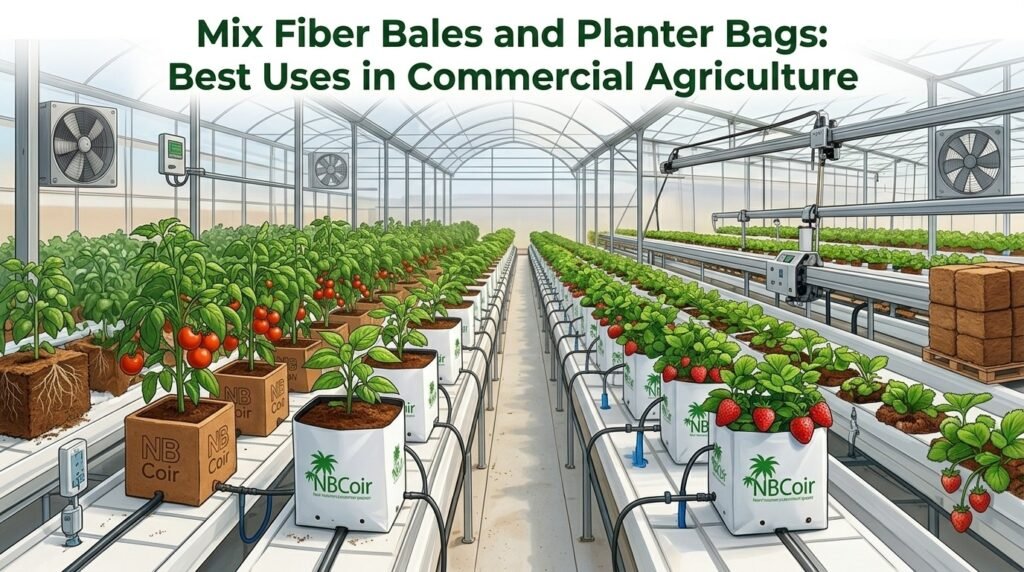
Mix fiber bales and planter bags are two of the most practical and widely used coco coir products in modern commercial agriculture. Both are made from renewable coconut husk material and deliver excellent results in soil improvement, greenhouse production, and soilless growing systems.
This guide explains exactly what mix fiber bales and planter bags are, their key benefits, and the best commercial applications so you can choose the right product for your farm or greenhouse operation.
What Are Mix Fiber Bales?
Mix fiber bales are large compressed bales made from a blend of coconut coir fibers (usually a combination of longer bristle fiber and shorter mixed fiber). They typically weigh between 125–150 kg and are supplied in dense, easy-to-transport form.
Once opened and fluffed (or lightly hydrated), the fibers provide excellent structure, aeration, and durability. In commercial agriculture they are mainly used as:
- A soil amendment to improve drainage and prevent compaction
- A blending material with coco peat for custom growing media
- An erosion-control and landscaping material
- A bulk substrate component in hydroponic and greenhouse systems
What Are Planter Bags?
Planter bags are ready-to-use bags pre-filled with high-quality coco coir (usually a mix of coco peat and coco chips). They come in different sizes and are designed for direct planting of commercial crops under greenhouse or polyhouse conditions.
Growers simply place the bags in rows, cut planting holes, connect drip irrigation, and transplant seedlings. No mixing or filling is required.
Key Benefits of Mix Fiber Bales and Planter Bags in Commercial Agriculture
| Benefit | Mix Fiber Bales | Planter Bags |
|---|---|---|
| Improves soil structure | Excellent | Good |
| Water retention & drainage | High (when blended) | Excellent |
| Root aeration | Very high | High |
| Disease reduction | Moderate | High (sterile medium) |
| Ease of use | Needs fluffing/blending | Ready-to-use |
| Suitability for greenhouses | Good as blend | Outstanding |
| Sustainability | Fully renewable | Fully renewable & biodegradable |
| Cost efficiency at scale | Very high | High |
Best Uses of Mix Fiber Bales in Commercial Agriculture
Soil Conditioning and Amendment
Mix fiber bales are excellent for improving heavy clay soils or sandy soils. The long fibers create air channels, reduce compaction, and improve water infiltration. Many large farms mix the fibers into open-field beds before planting vegetables or orchards.
Custom Growing Media Blends
Commercial nurseries and greenhouse operators blend mix fiber with coco peat (for example 30% fiber + 70% peat) to create substrates with superior structure and longer-lasting aeration. This is especially useful for long-cycle crops.
Erosion Control and Landscaping
The strong, interlocking fibers make mix fiber bales ideal for slope stabilization, riverbank protection, and large-scale landscaping projects around commercial farms.
Bulk Hydroponic and Greenhouse Substrate
When cost per litre is critical, mix fiber bales can be hydrated and used as a bulk component in large hydroponic systems or as a base layer under other media.
Best Uses of Planter Bags in Commercial Agriculture
Greenhouse Vegetable Production
Planter bags are the preferred system for high-wire tomatoes, cucumbers, bell peppers, and eggplants in modern greenhouses. They deliver consistent yields, excellent root health, and precise fertigation control.
Berry Production (Strawberries, Blueberries, Raspberries)
Elevated planter bags keep fruit clean, reduce soil-borne diseases, and allow better control of moisture and nutrition — resulting in higher quality and longer shelf-life berries.
Soilless and Hydroponic Systems
Because the medium is clean and uniform, planter bags work perfectly with drip irrigation and recirculating nutrient systems. They reduce the risk of soil-borne pathogens compared with traditional ground culture.
Nursery and Container Production
Larger planter bags are also used for growing young fruit trees, ornamental plants, and high-value container crops where root zone control is important.
How to Choose Between Mix Fiber Bales and Planter Bags
- Choose Mix Fiber Bales when you need bulk material for soil improvement, custom blending, erosion control, or large-volume substrate mixing.
- Choose Planter Bags when you want a ready-to-plant, consistent, high-performance system for greenhouse or intensive commercial crop production.
Many progressive farms use both: mix fiber bales for open-field soil improvement and planter bags inside greenhouses for high-value crops.
Practical Tips for Maximum Results
- Always use low-EC, washed, and preferably buffered coir products for sensitive crops.
- For planter bags, follow the recommended volume per plant (usually 8–15 litres depending on the crop).
- Ensure good drainage slits and proper drip irrigation placement.
- Monitor EC and pH regularly, especially in the first weeks after planting.
- Store unused mix fiber bales in a dry place to maintain quality.
Conclusion
Mix fiber bales and planter bags are powerful tools for commercial agriculture. Mix fiber bales excel at improving soil structure and providing bulk sustainable material, while planter bags deliver precision, consistency, and higher yields in greenhouse and soilless systems.
By selecting the right product for each application, commercial growers can reduce disease pressure, improve water and nutrient efficiency, and achieve more predictable, profitable harvests — all while using a renewable, peat-free resource.
Frequently Asked Questions
What is the difference between mix fiber bales and planter bags?
Mix fiber bales are compressed bulk coconut fiber used mainly for soil amendment and blending. Planter bags are ready-to-use bags pre-filled with coco coir growing medium designed for direct crop production.
Are mix fiber bales and planter bags suitable for organic farming?
Yes. Both are made from natural coconut fiber and are widely accepted in organic and sustainable farming systems when no synthetic additives are used.
Which crops perform best in planter bags?
Tomatoes, cucumbers, bell peppers, strawberries, blueberries, and melons show excellent results in quality planter bags.
How long do planter bags last?
Most commercial planter bags are designed for one full crop cycle (6–12 months). Some high-quality bags can be reused for a second cycle after proper sterilization.
Can mix fiber bales be used directly as a growing medium?
They are usually blended with coco peat or other materials. Pure fiber is excellent for structure but may need additional fine material for moisture retention.