 info@nbcoir.com
 +94
+94 
What Is Coco Peat? Coco Coir Guide for Beginners
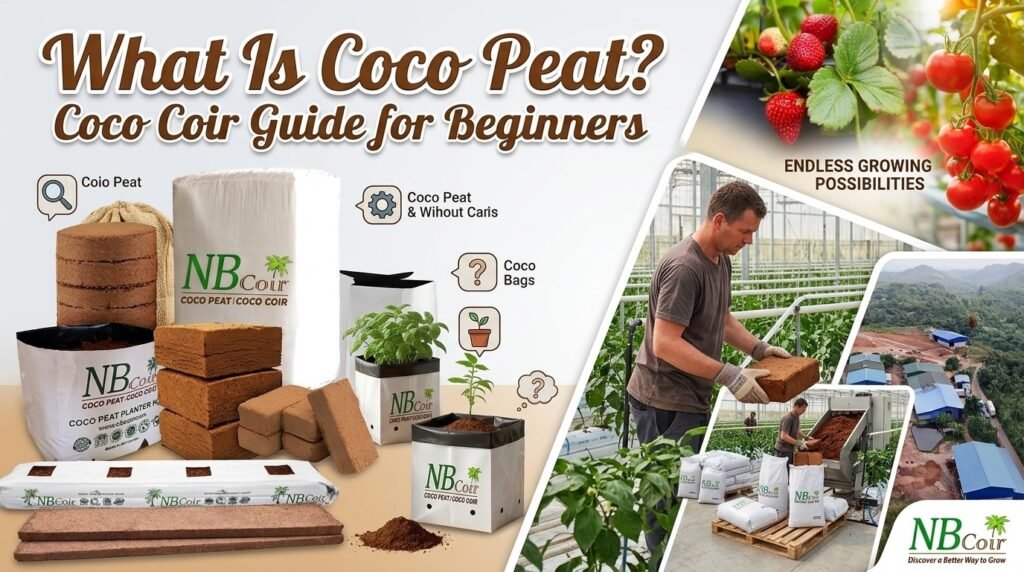
If you are new to gardening, greenhouse cultivation, or hydroponics, you may have come across the terms Coco Peat and Coco Coir.
What is coco peat, how is it made from coconut husks, and why is it used as a growing medium? Is coco peat the same as coco coir? Is coco peat the same as coco coir? And why is it used as a growing medium?
In this beginner’s guide, we explain everything you need to know about coco peat, coco coir, their differences, benefits, uses, and important specifications to consider when buying them.
What Is Coco Peat?
Coco peat is a natural growing medium obtained by processing the coconut husk, the fibrous material found around the coconut.
During coconut husk processing, different coir components can be separated. The fine, peat-like material is commonly used as coco peat, while other components such as coco chips and coir fibre can be used for different agricultural and industrial applications.
One of the main reasons coco peat is widely used as a growing medium is its ability to support:
💧 Moisture retention
🌬️ Root-zone aeration
🚿 Drainage
🌱 Plant root development
Coco peat is used in a variety of growing systems, including:
🌱 Greenhouse cultivation
💧 Hydroponic farming
🌿 Nurseries
🥬 Commercial agriculture
🌸 Floriculture
🪴 Home gardening
🌾 Soilless growing systems
For commercial growers, coco peat can also be supplied in different product formats and specifications depending on the crop and growing system.
How is Coco Peat Made?
The main raw material used to produce coco peat is coconut husk.
Although the exact manufacturing process can vary depending on the product and required specifications, the basic process can be understood through these stages.
1. Coconut Husk Collection
Coconut husks are collected and selected as the primary raw material for coir processing.
The quality of the raw material is important because it can influence the consistency and quality of the finished product.
2. Husk Processing
The coconut husk is mechanically processed to separate the different coir components.
This can produce materials such as:
Coco peat
Coco chips
Coir fibre
3. Coco Peat Separation
The fine, peat-like material is separated from the other coir components.
This material can then be processed according to the intended agricultural application.
4. Screening and Processing
The coco peat can be screened and processed to achieve the required particle size and consistency.
5. Washing and EC Management
Depending on the required specification, coco peat may undergo washing or other processing steps.
For commercial growers and hydroponic applications, EC level can be an important consideration when selecting a coco peat product.
6. Drying and Compression
After processing, the material can be dried and compressed into different product formats.
These can include coco peat bricks, blocks, briquettes, grow bags, and other customized growing media products.
For example, commercial buyers can use products such as 5KG Coco Peat Bricks for different cultivation applications.
Why Is Coco Peat Made From Coconut Husk?
Coconut husk is a natural coir resource that can be processed into useful agricultural materials.
Instead of treating the husk simply as waste, different components can be processed and used for growing media, fibre products, and other applications.
This makes coco-based products useful across both agriculture and other industries.
What Is the Difference Between Coco Peat and Coco Coir?
This is one of the most common questions for people who are new to coco-based growing media.
Although the terms Coco Peat and Coco Coir are sometimes used interchangeably, they do not always refer to exactly the same material.
Coco Peat
Coco peat is the fine, peat-like material obtained from processing coconut husks.
It is commonly used as a growing medium or as a component of growing media mixes.
Typical applications include:
Moisture management
Seed propagation
Greenhouse cultivation
Hydroponic growing
Nursery production
Soilless cultivation
Coco Coir
Coco coir is a broader term used for coir-based materials obtained from coconut husks.
Depending on the context, this can include:
Coco peat
Coco chips
Coir fibre
Products made from these materials
For example, Coco Coir Grow Bags and Coco Coir Planter Bags are commercial products made using coco-based growing media.
A simple way to remember it:
- Coco Peat = Fine growing-medium material
- Coco Coir = Broader category of coconut-husk coir materials and products
So, while coco peat is a type of coco-based material, Coco Coir is the broader term.
Key Benefits of Coco Peat
Why has coco peat become such a popular growing medium?
Here are some of its main benefits.
💧 Good Water Retention
Coco peat can retain moisture and help support efficient water management around plant roots.
This can be particularly useful in controlled growing systems where irrigation needs to be managed carefully
🌬️ Root-Zone Aeration
A suitable coco peat structure can help maintain air spaces around plant roots.
Good aeration is important for healthy root-zone conditions.
🚿 Balanced Drainage
Coco peat can retain moisture while also allowing excess water to drain.
The balance between water retention and drainage is an important characteristic of a growing medium.
🌱 Suitable for Soilless Growing
Coco peat can be used as a growing medium or as part of a growing media mix in suitable soilless cultivation systems.
It is therefore commonly used in greenhouse and hydroponic growing.
♻️ Coconut-Based Natural Material
Because coco peat is derived from coconut husks, it provides a way to use a natural coir resource for agricultural applications.
Where Is Coco Peat Used?
Coco peat can be used across different cultivation environments.
🌿 Greenhouse Cultivation
Coco-based growing media can be used for crop production in controlled greenhouse environments.
For commercial greenhouse growers, products can be selected according to crop, irrigation system, EC requirements, and other specifications.
💧 Hydroponic Farming
Coco peat and coco chips can be used as growing media in suitable soilless and hydroponic systems.
For larger commercial operations, products such as 25KG Coco Coir Bricks can provide a compressed format for bulk applications.
🌱 Nurseries
Coco-based growing media can be used for seedlings, young plants, propagation, and nursery production.
For propagation applications, compact products such as Coco Coir Discs can also be used.
🥬 Commercial Agriculture
Commercial growers can use customized coco peat products and growing media mixes according to their crop and cultivation requirements.
🌸 Floriculture
Coco-based growing media can also be used for flowers and ornamental plants.
Why Is Coco Peat a Good Growing Medium for Plants?
When choosing a growing medium, there is no single characteristic that determines whether it is suitable.
A good growing medium needs to support several important conditions:
Water + Air + Drainage + Root Support
Coco peat, when processed to suitable specifications, can help provide a balance between moisture retention and root-zone aeration.
This is one reason coco-based growing media are used by greenhouse growers, nurseries, hydroponic growers, and other commercial cultivation operations.
However, the most suitable coco peat specification depends on the crop, growing system, irrigation method, and required EC and composition.
What Should You Look for When Buying Coco Peat?
If you are buying coco peat for commercial cultivation or importing it in bulk, don’t choose a product based only on the word “premium.”
Look at the actual product specifications.
EC Level
The required EC level can vary depending on the crop and cultivation system.
For commercial growing, buyers should confirm whether the product is available in the required EC specification.
pH
A suitable pH range is another important consideration when selecting growing media.
Composition
Check whether you need:
100% coco peat
100% coco chips
Coco peat and chips
A customized peat-to-chip ratio
Expansion
For compressed coco peat products, expansion capacity is an important specification.
Consistency
Consistent quality between batches is especially important for commercial growers who require predictable growing media.
Packaging
For international buyers, packaging should be suitable for transportation, storage, and bulk handling.
Customization
Different crops and growing systems may require different product specifications.
Therefore, check whether the manufacturer can provide customized:
Sizes
Weights
EC levels
Compositions
Packaging
Quantities
Coco Peat Products
Coco peat and coco coir materials can be supplied in different formats depending on the application.
These can include:
If you are looking for a wider range of products, you can explore NB Coir’s Coco Peat and Coco Coir Products.
This is a good place to put an internal link because the reader has now learned what coco peat is and may want to see actual products.
Frequently Asked Questions
Is Coco Peat the Same as Coco Coir?
Not exactly.
Coco peat refers to the fine, peat-like material obtained from processing coconut husks, while coco coir is a broader term for coconut-husk-based coir materials and products.
Is Coco Peat Made From Coconut Husks?
Yes. Coco peat is obtained by processing coconut husks and separating the fine, peat-like coir material.
Is Coco Peat Good for Plants?
Coco peat with suitable quality and specifications can be used as a growing medium to support moisture retention, drainage, and root-zone aeration.
Can Coco Peat Be Used for Hydroponics?
Yes. Coco peat and other coco-based growing media can be used in suitable hydroponic and soilless cultivation systems.
However, the product’s EC, composition, and other specifications should be appropriate for the crop and growing system.
What Products Can Be Made From Coco Peat?
Coco peat can be processed and compressed into different formats, including bricks, blocks, briquettes, grow bags, and other customized growing media products.
Conclusion
Coco Peat is a natural growing medium obtained from processing coconut husks.
Its ability to support moisture retention, drainage, and root-zone aeration makes it useful for applications such as greenhouse cultivation, hydroponics, nurseries, floriculture, and commercial agriculture.
Understanding the difference between Coco Peat and Coco Coir can also help growers and buyers choose the right type of coir-based product for their needs.
For commercial applications, it is important to consider specifications such as EC, pH, composition, expansion, consistency, packaging, and customization rather than choosing a product based only on general descriptions.
NB Coir manufactures and exports coco peat and coco coir products from Sri Lanka for commercial growers, distributors, and international buyers, with customized specifications available for different requirements.