 info@nbcoir.com
 +94
+94 
How to Prepare and Buffer Coco Peat Before Use
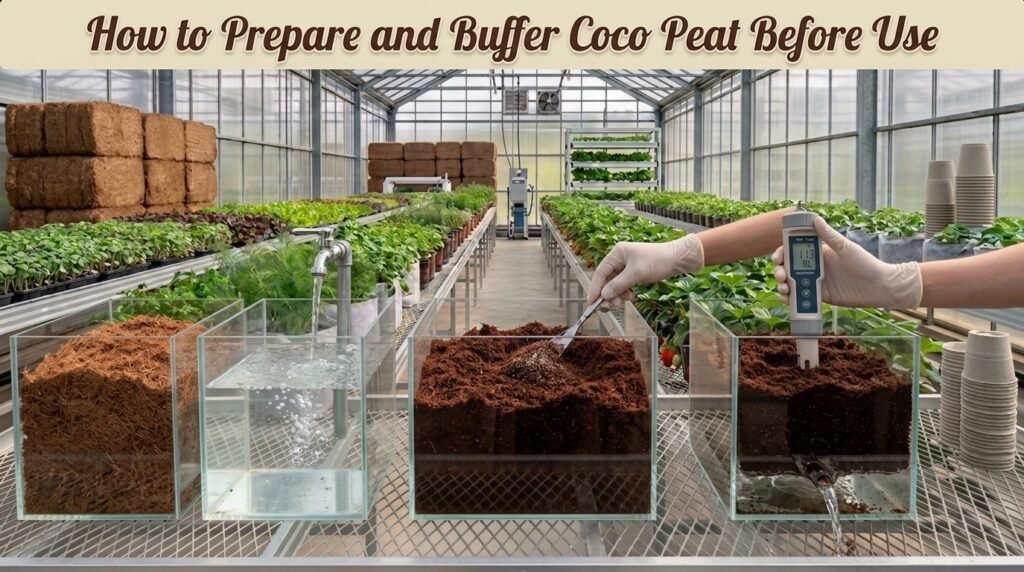
Learning how to prepare coco peat properly is important before using it for hydroponics, greenhouse production, nurseries, container gardening, and commercial horticulture. Depending on its source and processing method, coco peat may contain soluble salts and exchangeable ions that can affect the root-zone environment.
Proper coco peat preparation may involve hydrating, washing, buffering with calcium and magnesium, rinsing, and checking the final EC and pH. However, not every coco peat product requires the same preparation process. Professionally washed and buffered coco peat may already be ready for use according to its specified application.
In this guide, you will learn how to prepare coco peat step by step, when washing is necessary, how coco peat buffering works, and the common mistakes to avoid.
What Is Coco Peat?
Coco peat, also called coco coir pith or coco coir peat, is a growing medium made from coconut husk material. It has useful physical properties for plant production, including good water-holding capacity, air-filled porosity, and root-zone structure.
Coco peat can be supplied in different forms, including:
- Loose coco peat
- Compressed coco peat blocks
- Coco peat briquettes
- Grow bags
- Coco peat and coco chip blends
The material can also be produced to different specifications, including different EC levels, particle sizes, moisture levels, and peat-to-chip ratios.
Why Does Coco Peat Need to Be Prepared?
Not every coco peat product requires the same level of preparation.
Commercial coco peat that has already been properly washed, buffered, tested, and supplied at the required EC may be ready to use after hydration. In contrast, raw or insufficiently processed coco peat may require additional washing and conditioning.
The main reasons for preparing coco peat are to:
- Reduce unwanted soluble salts
- Improve control over the starting EC
- Reduce excess ions that may interfere with nutrient management
- Create a more suitable root-zone environment
- Prepare the material for fertigation or hydroponic use
For commercial growing, it is important to check the supplier’s product specifications before deciding whether additional washing or buffering is necessary.
How to Prepare Coco Peat Step by Step
Preparing coco peat correctly depends on its starting EC, pH, processing history, and intended application. A typical preparation process includes hydration, washing when required, buffering, rinsing, and final testing.
The basic steps are:
- Check the coco peat specifications before preparing it.
- Hydrate the compressed coco peat with clean water.
- Wash the coco peat if additional salt removal is required.
- Prepare a calcium and magnesium buffering solution.
- Apply the buffering solution according to the selected protocol.
- Rinse and drain the coco peat when required.
- Check the prepared coco peat’s EC, pH, moisture, and physical condition.
- Check the final pH and EC before planting.
- Use the prepared coco peat for the intended growing application.
Step 1: Check the Coco Peat Before Preparing It
Before adding water, check what type of coco peat you have purchased.
Look for information such as:
- Electrical conductivity (EC)
- pH
- Moisture content
- Expansion ratio
- Particle size
- Peat-to-chip ratio
- Whether the product is washed
- Whether the product is buffered
- Recommended application or preparation instructions
If the manufacturer provides a certificate of analysis or product specification sheet, use those values as your starting point.
Why EC Matters
Electrical conductivity indicates the concentration of dissolved salts in a growing medium or solution.
A higher EC does not automatically mean that coco peat is unsuitable. Different crops and production systems can have different requirements. However, growers need to understand the starting EC so that irrigation and nutrient management can be planned appropriately.
For this reason, do not automatically wash every coco peat product without first checking its specifications.
Before deciding how to prepare coco peat, check whether the material has already been washed and buffered by the supplier.
Step 2: Hydrate the Coco Peat
If you are using compressed coco peat, the first step is to add clean water and allow the material to expand.
Place the compressed block, brick, or briquette in a clean container with enough space for expansion.
Add water gradually and allow the coco peat to absorb it.
As it expands:
- Break apart the compressed material.
- Mix the hydrated coco peat evenly.
- Remove large pieces of foreign material if present.
- Allow the material to become fully hydrated.
Avoid compacting the coco peat after hydration because excessive compaction can reduce air-filled pore space.
Step 3: Wash the Coco Peat
Washing is used when the coco peat requires reduction of soluble salts or other water-soluble components.
After hydration, place the coco peat in a suitable clean container or washing system and flush it with clean water.
A basic process is:
- Hydrate the coco peat.
- Add clean water.
- Mix the material thoroughly.
- Allow excess water to drain.
- Repeat the washing process if necessary.
- Measure the EC of the drained water or prepared coco peat.
- Continue until the material reaches the required specification.
The amount of water required depends on the initial EC, coco peat quality, drainage conditions, and the target specification.
Should You Always Wash Coco Peat?
No.
If you purchase professionally washed and low-EC coco peat, additional intensive washing may not be necessary.
Over-washing can also waste water and nutrients and may make the preparation process unnecessarily complicated.
The correct approach is to test first and prepare according to the product specification and crop requirements.
Step 4: Understand Coco Peat Buffering
Washing and buffering are not the same process.
Washing primarily removes soluble salts. Buffering is used to condition the cation exchange sites of coco peat.
Coco peat has a cation exchange capacity (CEC), meaning it can hold positively charged ions, commonly called cations.
Important cations in plant nutrition include:
- Calcium (Ca²⁺)
- Magnesium (Mg²⁺)
- Potassium (K⁺)
- Sodium (Na⁺)
Coco peat can contain relatively high amounts of potassium and other exchangeable cations depending on the raw material and processing method.
During buffering, calcium and/or magnesium are supplied so that exchange sites can become occupied by these nutrients rather than unwanted or excessive amounts of other cations.
Step 5: Prepare a Calcium and Magnesium Buffering Solution
A common commercial approach is to use a solution containing calcium and magnesium sources.
For example, growers may use calcium nitrate and magnesium sulfate or other suitable calcium and magnesium inputs depending on their system.
However, there is no single universal buffering recipe for every coco peat product.
The appropriate concentration and duration depend on:
- Initial coco peat chemistry
- CEC
- Initial EC
- Crop requirements
- Water quality
- Product specification
- Buffering method
- Whether the coco peat has already been buffered
For this reason, follow the manufacturer’s recommended buffering procedure whenever one is available.
Step 6: Apply the Buffering Solution
Once the coco peat has been adequately washed when required, the buffering solution can be applied.
A general process is:
- Prepare the calcium/magnesium solution according to the selected protocol.
- Make sure the coco peat is evenly hydrated.
- Apply the solution thoroughly throughout the material.
- Mix the coco peat so that the solution reaches the entire growing medium.
- Allow sufficient contact time according to the buffering protocol.
- Drain the excess solution.
The goal is to provide sufficient contact between the coco peat and the calcium/magnesium solution.
For large commercial operations, buffering is normally performed under a controlled process rather than by simply pouring a small amount of solution over the material.
Step 7: Rinse and Check the Coco Peat
After buffering, the material may require rinsing depending on the buffering method and the target crop.
The prepared coco peat should then be checked for relevant parameters such as:
- EC
- pH
- Moisture
- Physical structure
- Drainage
- Expansion
Testing is particularly important for commercial growers because a growing medium that looks clean does not necessarily have the desired chemical characteristics.
Step 8: Check pH Before Planting
Coco peat generally has a naturally suitable pH range for many horticultural applications, but the actual value depends on the product and preparation process.
Measure the pH after preparation rather than relying only on a general expected value.
Remember that pH and EC measure different things:
- pH indicates acidity or alkalinity.
- EC indicates the concentration of dissolved ions and salts.
Both can be important when managing a coco-based growing medium.
Step 9: Use the Prepared Coco Peat
Once the coco peat has reached the required specification, it can be used for applications such as:
- Hydroponics
- Greenhouse production
- Nurseries
- Container growing
- Seedling production
- Floriculture
- Horticulture
- Potting mixes
- Commercial vegetable production
For hydroponic and greenhouse production, continue monitoring the root-zone EC and pH because conditions can change after irrigation and fertilizer application.
Common Mistakes When Preparing Coco Peat
1. Assuming All Coco Peat Is the Same
Different coco peat products can have different EC levels, particle sizes, moisture contents, and processing methods.
Always check the product specification before deciding how much preparation is required.
2. Washing Without Measuring EC
Simply washing coco peat repeatedly does not tell you whether it has reached the required condition.
Whenever possible, measure EC before and after washing.
3. Confusing Washing With Buffering
Washing removes water-soluble salts.
Buffering is a different process involving the exchange of cations on the coco peat’s exchange sites.
Doing one does not automatically mean that the other has been completed.
4. Using an Uncontrolled Buffering Recipe
There is no single calcium or magnesium concentration that should automatically be applied to every coco peat product.
Using an unnecessarily strong solution can create another EC-management problem.
Use a validated supplier or agronomic protocol appropriate to the material.
5. Ignoring Water Quality
The quality of the water used for washing and buffering can affect the final result.
Water may contain measurable levels of:
- Calcium
- Magnesium
- Sodium
- Bicarbonates
- Other dissolved salts
For commercial production, testing irrigation water can therefore be important.
6. Skipping the Final Test
A coco peat product can look perfectly clean while still having an EC or pH that is not suitable for the intended application.
Test the prepared material before planting whenever practical.
Do You Need to Buffer Commercial Coco Peat?
This depends on the product you purchase.
If the supplier provides coco peat that has already been:
- Washed
- Buffered
- Tested
- Produced to a specified EC
- Prepared for the intended application
then additional buffering may not be required.
This is one reason commercial growers should ask suppliers for detailed product specifications before purchasing.
Questions to ask your coco peat supplier include:
- What is the EC?
- What is the pH?
- Is the coco peat washed?
- Is it buffered?
- What buffering process was used?
- What is the expansion ratio?
- What is the particle size?
- Is the product suitable for hydroponics or greenhouse production?
- Can you provide a product specification or test report?
Low-EC Coco Peat vs. High-EC Coco Peat
Coco peat is available in different EC specifications for different applications.
Low-EC coco peat is processed to contain a lower level of soluble salts and can be useful when growers want greater control over the nutrient solution.
Higher-EC coco peat may be suitable for applications where the grower has an appropriate nutrient and irrigation management program.
The correct choice depends on the crop, growing system, water quality, fertilizer program, and production requirements.
For commercial growers, the important point is to select coco peat based on measured specifications rather than the product name alone.
How Long Does Coco Peat Preparation Take?
There is no universal preparation time.
The duration depends on:
- The starting condition of the coco peat
- Compression level
- Initial EC
- Washing requirements
- Buffering method
- Contact time
- Drainage
- Water quality
- Target specification
Commercially processed coco peat can significantly reduce the amount of preparation required by the end user.
Can You Use Coco Peat Without Buffering?
Yes, depending on the product.
If the coco peat has already been professionally processed and supplied according to the required EC and buffering specification, additional buffering may not be necessary.
However, raw or inadequately processed coco peat may require further preparation.
Always check the supplier’s specifications before use.
Final Checklist Before Using Coco Peat
Before planting, check the following:
- Coco peat is fully hydrated
- Initial EC has been checked
- Washing was performed if required
- Buffering requirement has been confirmed
- Calcium/magnesium treatment was applied according to the selected protocol
- Excess solution was drained
- Final EC was checked
- pH was checked
- Physical structure and drainage are suitable
- Product specifications match the crop and growing system
Choose Coco Peat According to Your Growing Requirements
Proper preparation of coco peat starts with understanding the material you have.
While washing can help reduce soluble salts, buffering is a separate process that addresses the exchangeable cations associated with the growing medium. The exact preparation method should therefore be based on the initial EC, chemical characteristics, water quality, crop requirements, and supplier specifications.
For commercial growers, using professionally processed coco peat with clearly defined EC, pH, particle size, and buffering specifications can simplify preparation and provide greater consistency.
NB Coir supplies export-quality coco peat and coco coir growing media from Sri Lanka, with product specifications available for different commercial applications. Coco peat can be supplied in different EC levels, compositions, and formats according to buyer requirements.
Looking for coco peat for hydroponics, greenhouses, nurseries, or commercial growing? Contact NB Coir to discuss your required specifications.
Frequently Asked Questions About Coco Peat Preparation
How do you prepare coco peat before use?
To prepare coco peat before use, first check its EC, pH, and processing specifications. Hydrate compressed coco peat, wash it if necessary, apply an appropriate calcium and magnesium buffering treatment when required, and check the final EC and pH before planting.
Do you need to wash coco peat before using it?
Not always. Professionally processed coco peat may already be washed and supplied at a specified EC. Raw or insufficiently washed coco peat may require additional washing. Check the supplier’s specifications before deciding whether further washing is necessary.
How do you buffer coco peat?
Coco peat buffering generally involves treating the hydrated material with a suitable calcium and/or magnesium solution to condition its cation exchange sites. The appropriate concentration, contact time, and procedure depend on the coco peat’s chemical properties and the growing application.
Can coco peat be used without buffering?
Yes, depending on the product. If the coco peat has already been professionally buffered and supplied according to the required specifications, additional buffering may not be necessary.
What is the difference between washing and buffering coco peat?
Washing primarily helps remove soluble salts from coco peat. Buffering is a separate process that conditions exchangeable cations on the coco peat’s cation exchange sites. Washing and buffering therefore serve different purposes.
Should you check EC after preparing coco peat?
Yes. Checking the final EC can help confirm that the prepared coco peat is within the desired specification for the intended crop and growing system.
Can coco peat be used for hydroponics?
Yes. Coco peat is widely used as a growing medium in hydroponic and greenhouse production. The appropriate EC, particle size, drainage, water management, and nutrient program depend on the crop and production system.