 info@nbcoir.com
 +94

Common Problems with Coco Peat and How to Fix Them
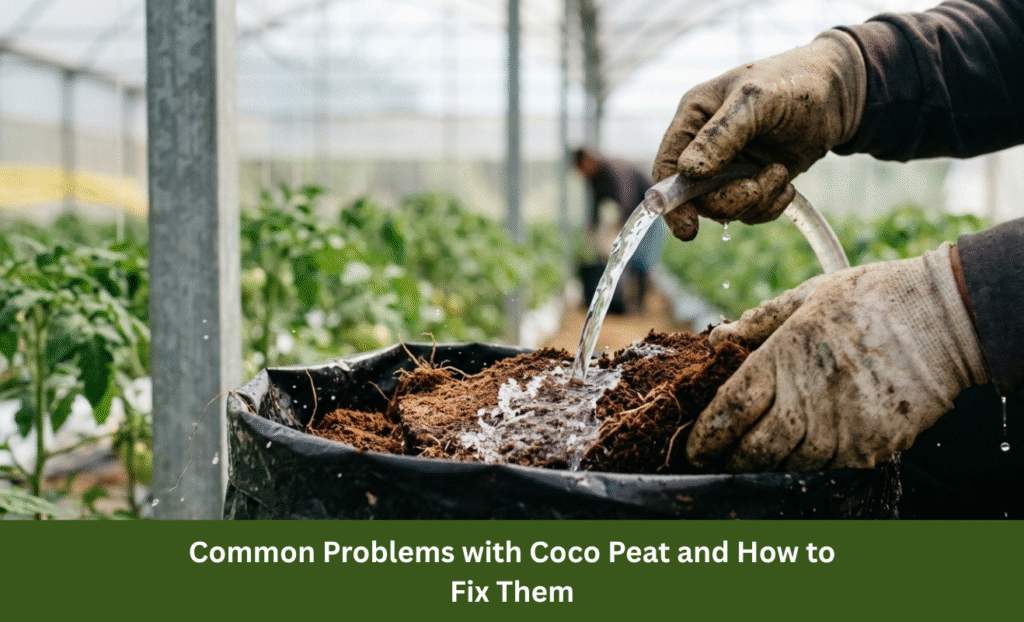
Salt buildup, nutrient lockout, pH drift, and compaction
Coco peat problems are more common than many growers expect. Even high-quality coco can develop salt buildup, nutrient lockout, pH drift or compaction if not managed properly. Here’s how to identify and fix the four most frequent issues.
But like any medium, it can develop problems if salts accumulate, pH drifts, or the structure starts to break down. The four issues growers run into most often are salt buildup, nutrient lockout, pH drift, and compaction.
Here’s a clear look at each one — what it looks like, why it happens, and exactly how to fix it.
Common Coco Peat Problems: Salt Buildup
What it looks like
- Leaf tip burn (brown, crispy edges)
- White crust on the surface of the medium or sides of pots
- Plants looking thirsty even when the medium is wet
- Runoff EC climbing higher than your feed EC
Why it happens
Coco has a high cation exchange capacity. Fertiliser salts, sodium from hard water, and residual salts from the coir itself can accumulate if you don’t get enough runoff or if you push drybacks too far. Over time the root zone becomes overloaded with salts.
How to fix it
- Aim for 15–20% runoff with every feed. This constantly flushes excess salts.
- If runoff EC is already 0.4–0.5 or more above your feed EC, do a corrective flush: run pH-adjusted water (or a very light nutrient solution at 0.4–0.6 EC) through the medium until the runoff EC drops close to your target.
- After the flush, resume feeding at a slightly lower EC for a few days, then return to normal.
- Always start with low-EC, properly washed and buffered coco. High-quality product makes salt management far easier.
How to Fix Nutrient Lockout in Coco Peat
What it looks like
- Multiple deficiency symptoms appearing at the same time (yellowing + brown spots + tip burn)
- Plants stop growing even though you are feeding regularly
- New growth looks worse than older leaves
Why it happens
Lockout is usually caused by high EC (salt buildup) or pH moving outside the ideal range. When the osmotic pressure in the root zone gets too high, roots simply cannot take up water and nutrients. High or low pH also makes specific elements unavailable (iron and manganese lock out above pH 6.5; calcium and magnesium lock out below 5.5).
How to fix it
- Test both feed and runoff EC and pH.
- If runoff EC is significantly higher than feed EC → flush as described above.
- If pH is out of range → correct the pH of your next few feeds and monitor runoff.
- Once the medium is balanced again, resume a complete coco-specific nutrient program that includes enough calcium and magnesium.
Never respond to lockout by simply increasing nutrient strength — that usually makes it worse.
Solving pH Drift – One of the Biggest Coco Peat Problems
What it looks like
- Gradual yellowing of new growth (often iron-like symptoms)
- Calcium or magnesium deficiency signs even when Cal-Mag is being added
- Runoff pH slowly moving outside 5.5–6.5
Why it happens
Coco has limited buffering capacity compared with soil. Plant nutrient uptake, water alkalinity, and residual sodium/potassium on the coir’s exchange sites all push pH over time. Unbuffered or poorly buffered coco is especially prone to drift in the first few weeks.
How to fix it
- Always feed in the 5.8–6.2 range for most crops.
- Check runoff pH regularly (at least weekly).
- If runoff pH has risen above 6.3, flush with slightly lower pH water (around 5.5–5.8) until runoff stabilises.
- If pH has dropped too low, use water closer to 6.2–6.5 for a few irrigations.
- Start with properly buffered coco and use a nutrient line formulated for coco — this keeps the cation balance stable and reduces drift.
Compaction: A Frequent Coco Peat Problem and Its Fix
What it looks like
- Medium stays wet for a long time after watering
- Poor drainage and reduced oxygen in the root zone
- Roots looking brown or stressed
- Plants wilting even though the pot feels heavy
Why it happens
Over multiple cycles, coco fibres break down into finer particles. Too much pith and not enough coarse fibre or perlite also leads to compaction. Once the structure collapses, air spaces disappear and roots suffer.
How to fix it
- Mix in 20–30% perlite or coco chips when the medium starts feeling dense.
- Avoid over-watering once drainage slows.
- For reused coco, add 10–20% fresh material each cycle to restore structure.
- Choose a coco product with a good fibre-to-pith ratio from the start — higher fibre content resists compaction much longer.
Prevention Is Easier Than Cure
Most of these problems become rare when you start with high-quality, low-EC, properly buffered coco peat and follow a few simple habits:
- Always give 15–20% runoff
- Monitor runoff EC and pH regularly
- Use a complete coco-specific nutrient program with adequate Cal-Mag
- Don’t push extreme drybacks
Good coco peat is remarkably forgiving once these basics are in place. When problems do appear, the solutions above will usually get plants back on track quickly.
If you are looking for consistent, low-EC, well-buffered coco peat that minimises these issues from day one, that is exactly what we produce at NB Coir.