 info@nbcoir.com
 +94
+94 
Ultimate Guide to Coco Peat Bricks & Briquettes: 5kg vs 25kg Comparison
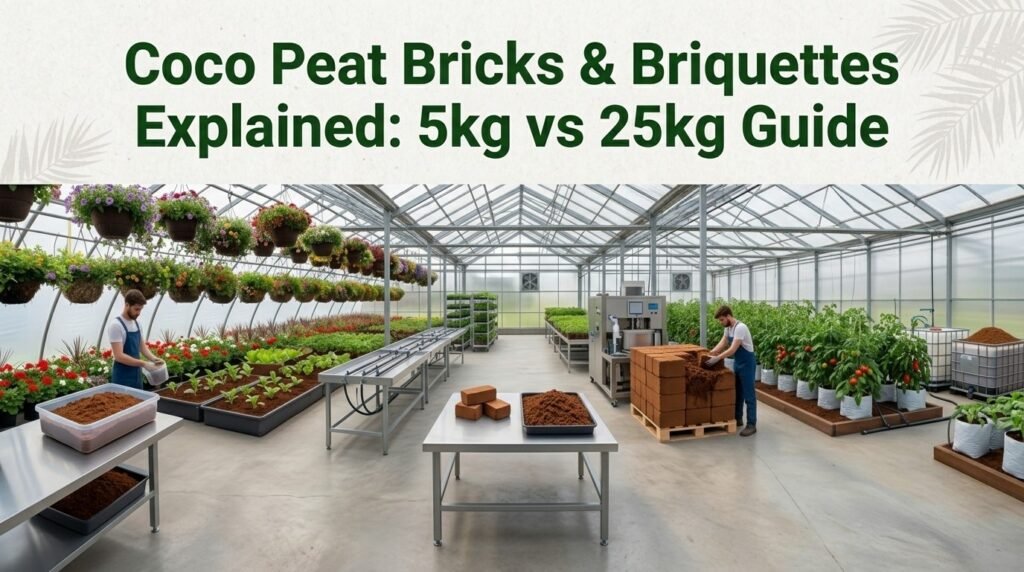
Coco peat bricks and briquettes are compressed forms of coconut coir pith — a renewable, peat-free growing medium made from coconut husks. They deliver excellent water retention, strong aeration, and healthy root support while staying lightweight and easy to store until you add water.
Choosing the correct size (small briquettes or larger 5kg / 25kg formats) affects cost, labour, storage, and performance. This complete guide explains the differences, real expansion ratios, and which option works best for nurseries versus commercial farms.
What Are Coco Peat Bricks and Briquettes?
Coco peat (also called coir pith or coco coir) is the fine, spongy material left after coconut fibre is extracted. It is washed, screened, dried, and compressed into two main forms:
- Briquettes — Smaller units, usually 650g (sometimes 500g or 315g). Typical size: 20 × 10 × 5 cm. Higher compression ratio (around 8:1).
- Blocks / Bricks — Larger units, most commonly 5kg (size approx. 30 × 30 × 10–15 cm). Compression ratio around 5:1. Some suppliers also offer 10kg or low-compression 25kg bales.
Both expand many times when hydrated, turning a hard dry block into light, fluffy growing media.
Expansion Ratios: How Much Media Do You Really Get?
Expansion volume is the most important number when comparing products.
| Size | Dry Weight | Premium Expansion | Standard Expansion | Approx. Litres per kg | Water Needed (approx.) |
|---|---|---|---|---|---|
| Briquette | 650g | 9–11 litres | 8–9 litres | 13–15 L | 3–5 litres |
| 5kg Block | 5kg | 70–80 litres | 60–70 litres | 12–16 L | 20–30 litres |
| 25kg Block | 25kg | Varies (often 250–350L+) | Lower density possible | Varies | Significantly more |
A good quality 5kg block normally expands to 70–75 litres. Premium grades can reach 80 litres. Always check the actual expansion volume stated by the supplier — higher expansion means better value per litre of finished media.
5kg Blocks vs Briquettes vs 25kg Formats
Small Briquettes (650g)
- Very easy to handle and store
- Perfect for home gardeners, retail packs, and small nurseries
- Expand quickly (15–30 minutes)
- Ideal for seed trays, individual pots, and small batches
- Higher cost per litre compared to larger blocks
5kg Blocks
- Industry standard for professional growers
- Best balance of handling ease and volume
- One block can fill multiple large pots or several grow bags
- Most cost-effective for medium to large nurseries and commercial farms
- Widely available in washed (low EC) and buffered versions
25kg and Larger Formats
True 25kg high-compression blocks are less common. More often you will find low-compression 25kg bales. These suit very large commercial operations that want to reduce packaging and handling frequency. They need more space and labour to expand.
Best Uses: Nurseries vs Commercial Farms
For Nurseries & Propagation
Nurseries need clean, consistent, easy-to-use media for seedlings and young plants.
Best choice: 650g briquettes or 5kg blocks (depending on your scale)
Why it works:
- Weed-free and disease-free
- Excellent moisture control and aeration for delicate roots
- Easy to portion for trays and small pots
- Mixes well with perlite, vermiculite, or compost (common ratio: 50–70% coco peat)
Small nurseries prefer briquettes for flexibility. Larger nurseries usually move to 5kg blocks for efficiency.
For Commercial Farms & Greenhouses
Commercial growers focus on cost per litre, labour savings, and consistent performance under intensive irrigation.
Best choice: 5kg blocks (main recommendation). Larger formats if your operation is very big.
Why it works:
- High volume reduces unpacking and hydration time
- Stable structure supports long-term crops (tomato, pepper, cucumber, strawberry, leafy greens)
- Excellent in pure coco systems or blends (e.g. 70% coco + 30% perlite)
- Low EC grades reduce salt problems in hydroponic or fertigation systems
- Buffered products lower the need for early calcium/magnesium adjustments
How to Expand Coco Peat Correctly
Expanding a 650g Briquette
- Place in a container larger than 12 litres
- Add 3–5 litres of water (warm water works faster)
- Wait 15–30 minutes
- Break apart by hand or with a fork until fluffy
- Drain any excess water
Expanding a 5kg Block
- Use a large tub or wheelbarrow (80+ litre capacity)
- Add 20–30 litres of water gradually
- Wait 20–45 minutes
- Break up all remaining hard pieces
- Aim for damp (not dripping) consistency
Pro tips:
- Warm water speeds expansion
- Fluff thoroughly for maximum air porosity
- Store unused expanded media covered
Quality Checklist Before You Buy
- EC level: Prefer low EC (<0.5–1.0 mS/cm)
- pH: Ideally 5.5–6.5
- Buffering: Calcium/magnesium buffered is better for most crops
- Moisture content: Usually under 15–20%
- Expansion volume: Ask for tested litres per block
- Particle size: Fine for propagation, coarser or mixed for longer crops
Quick Decision Guide
| Your Situation | Recommended Size | Why |
|---|---|---|
| Home garden / few pots | 650g briquettes | Convenient, low waste |
| Small–medium nursery | 650g briquettes or 5kg blocks | Flexibility + volume |
| Large commercial nursery | 5kg blocks | Efficiency |
| Greenhouse / hydroponic farm | 5kg blocks | Cost + consistency |
| Very large open-field amendment | 5kg or bulk 25kg | Volume efficiency |
Final Recommendation
- Nurseries → Start with 5kg blocks if you need regular volume. Keep 650g briquettes for precision work and retail.
- Commercial farms → 5kg blocks deliver the best combination of cost, labour savings, and performance.
Always prioritise actual expansion volume, low EC, and buffering quality over the cheapest price per kilogram. A premium 5kg block that expands to 75–80 litres almost always gives better results and lower cost per litre than a cheaper low-expansion product.
Choose the right size of coco peat bricks and briquettes and you will get consistent, high-performing growing media that supports strong roots and healthy plants — whether you run a small nursery or a large commercial farm.
Frequently Asked Questions
How much does a 5kg coco peat block expand?
A good quality 5kg coco peat block typically expands to 70–80 litres of ready-to-use growing medium.
- Premium / high-quality blocks: 75–80 litres
- Standard quality blocks: 60–70 litres
The exact expansion depends on compression quality, moisture content, particle size, and how thoroughly you hydrate and fluff the block. Always check the supplier’s stated expansion volume rather than assuming the highest figure.
How much water do I need to expand a 5kg coco peat block?
You will need approximately 20–30 litres of water for a 5kg block.
Start with 20–25 litres of water (warm water works faster). After 20–30 minutes, check the texture. If hard pieces remain in the centre, add a little more water and continue breaking it up. The final medium should be evenly moist and fluffy, not waterlogged. Excess water can be drained off.
How much does a 650g coco peat briquette expand?
A standard 650g briquette expands to 8–11 litres:
- Good quality: 9–11 litres
- Average quality: 8–9 litres
It usually needs only 3–5 litres of water and expands much faster than a 5kg block (often ready in 15–30 minutes).
Which is better for nurseries – 650g briquettes or 5kg blocks?
It depends on the scale of your nursery:
- Small nurseries or propagation-focused operations → 650g briquettes are better. They are easy to handle, reduce waste, and allow precise portioning for seed trays and small pots.
- Medium to large nurseries → 5kg blocks are more efficient. They save time and labour when preparing larger batches and offer better cost per litre.
Many professional nurseries keep both sizes — briquettes for precision work and 5kg blocks for bulk preparation.
Which size is best for commercial farms and greenhouses?
5kg blocks are the best choice for most commercial farms and greenhouses.
Reasons:
- Excellent balance between handling ease and volume
- Lower cost per litre of expanded media
- Suitable for hydroponics, grow bags, raised beds, and soil mixing
- Widely available in low-EC and buffered versions
Very large farms sometimes use 25kg low-compression bales, but 5kg blocks remain the industry standard because they are easier to hydrate and manage.